
What you’ll read: Clarity’s cheerleaders and critics alike have spent weeks wondering whether the bill will reach the Senate floor before the August recess. This week, they’ll get their answer, and the White House could play a major role in determining the outcome. Plus, the hack roiling the Bitcoin community, what to watch this week and other stories making headlines.
Of all the weeks that have been deemed “crucial” for the Clarity Act, this one arguably takes the cake.
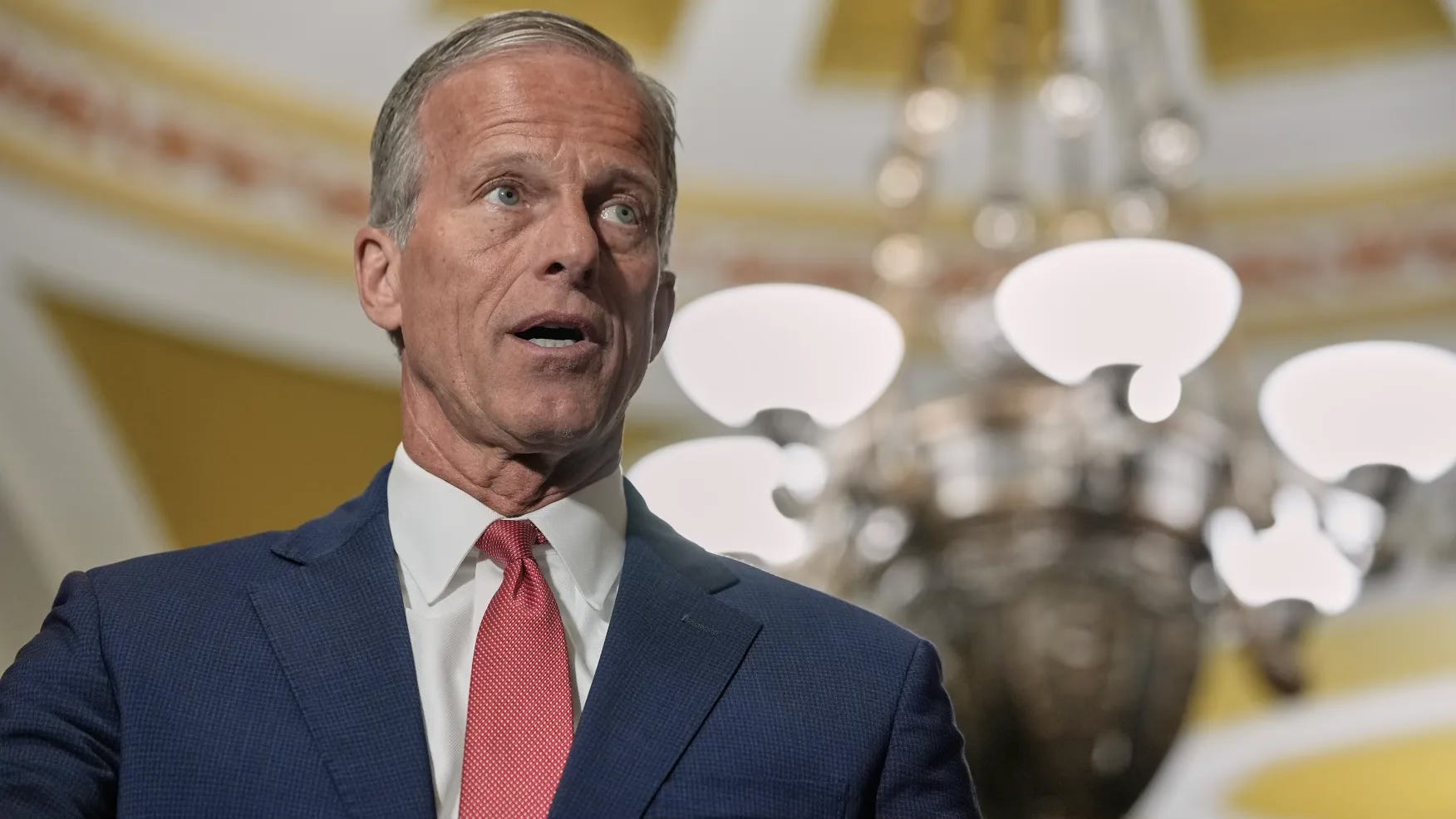
What happens over the next few days could determine whether the bill has enough momentum and political capital to cross the finish line. Under Senate rules, Majority Leader John Thune (R-SD) would need to file cloture on Tuesday to set up a Thursday vote if senators still expect to depart for the August recess on time.
But Thune told reporters Monday that he plans to keep the Senate in session until it finishes a laundry list of outstanding business. That list includes a continuing resolution to fund the government, a Russia sanctions bill, a nominations package, a possible vote on a college sports bill and a cloture vote on crypto market structure legislation — even as eleventh-hour negotiations continue over the bill’s three biggest issues: ethics, the Blockchain Regulatory Certainty Act and provisions in the Senate Agriculture portion of the text.
“I think market structure we’ll get a vote on,” he said. “Whether we can get on it or not, we’ll see.”
Translation from Senate-speak: Thune isn’t sure Republicans can secure the 60 votes needed to formally begin debate and consider amendments to the bill. That’s where the focus now turns.
The elephant in the room is that the White House has yet to respond to the ethics counteroffer sent last week by Senators Thom Tillis (R-NC) and Ruben Gallego (D-AZ), according to a source familiar with the negotiations. The revised proposal builds on an earlier agreement between the White House and two Senate Republicans and includes an enforcement role for state attorneys general, a provision Democrats have pushed for but the White House has resisted.
That silence could prove significant.
Without a bipartisan agreement on ethics, the bill is unlikely to attract enough Democratic support to secure the 60 votes needed to advance. Tillis has signaled that he will not support it without stronger ethics provisions, while other Republicans have expressed unease about the bill’s stablecoin yield language.
Some industry advocates who have remained largely optimistic throughout the process are now privately voicing concerns that Clarity could fail a procedural vote. If that happens, the bill’s path forward gets murky.
Others are taking a longer view.
“Big bills don’t move in straight lines. They stall, then get pulled back for another round of negotiation. Votes get scheduled and then don’t happen,” said Kristin Smith, president of the Solana Policy Institute. “This is normal, though still frustrating.”
Smith pointed to the GENIUS Act, which failed cloture before passing the Senate 68-30 weeks later and becoming law, as evidence that a procedural setback does not necessarily kill a bill. Others note two important distinctions: there was no summer recess between the GENIUS votes, giving opponents less time to potentially pick apart the legislation, and the bill moved in a nonelection year.
With the midterms looming, political calculations are playing a much larger role this time around.
Fairshake and its affiliates reported nearly $129 million in combined cash on hand as of June 30, giving the network a formidable war chest ahead of the midterms. That’s led some industry observers to suggest that a vote could help clarify where both Senate Democrats and Republicans stand and inform the super PAC network’s spending decisions ahead of November.
While Fairshake has already spent in several primaries this year, some Washington lobbyists believe the crypto money machine is still biding its time, waiting to see how lawmakers vote on Clarity before making its biggest midterm bets.
“It’s time to put people on the record,” Senator Cynthia Lummis (R-WY) told Crypto In America in a recent interview. “They’ll be given a choice: You either accept a bill that’s twice its original size because, at your request, we negotiated additional law enforcement, DeFi and ethics protections, or face the consequences of never getting to yes, no matter how much time we spend on this bill.”
For now, we’ll see whether Thune takes the first procedural step and files cloture as soon as today.
Coldcard Hack Rattles Bitcoin Community as Losses Top $100 Million

The security failure involving Coldcard, a popular Bitcoin-only hardware wallet used to store bitcoin offline, has now resulted in more than $100 million in losses, according to the latest analysis from Galaxy Research.
Coldcard, made by Canadian Bitcoin security firm Coinkite, is designed for self-custody, meaning users control the keys to their bitcoin rather than entrusting their assets to an exchange or another intermediary. The device had long been regarded as one of the more security-focused options among experienced bitcoin holders.
Until last week, when attackers began exploiting a software flaw dating to 2021 that made certain Coldcard recovery phrases easier to predict, allowing them to access the bitcoin without ever possessing the devices.
Galaxy, which has been tracking the thefts through onchain activity, says it has “high confidence” that 1,596 bitcoin was stolen from roughly 7,300 addresses across three major waves and 14 smaller incidents. Including suspected but unconfirmed activity, the potential losses climb to approximately $130 million, or 2,000 bitcoin.


What makes the breach particularly alarming is that victims weren’t phished and their devices weren’t remotely compromised. Coinkite believes AI may have helped uncover the flaw in its publicly available code, though that remains unconfirmed.
“The Coldcard hack has rattled the core of the Bitcoin community precisely because it hit people who did everything right,” Alex Thorn, Galaxy’s head of research, who is leading the firm’s analysis of the thefts, told Crypto In America. “They believe in the long-term vision, they stack bitcoin and they store it themselves. They didn’t lose their keys, they didn’t get phished, they didn’t speculate and lose their coins.”
“This is also a reckoning for the bitcoin and broader crypto security communities about the need for deep and continuous code audits, particularly in the age of AI,” he added.
In the days since the first thefts, Coinkite says it has released patched firmware, paused shipments and destroyed its remaining inventory containing the vulnerable software. But the company warns that installing the update will not secure an existing recovery phrase. Affected users must generate a new one and move their bitcoin.
The breach adds to a difficult stretch for the crypto industry, marked by a bear market, sector-wide layoffs, fading optimism over the passage of the Clarity Act and a string of major hacks. TRM Labs documented a record 207 crypto hacks during the first half of 2026, resulting in roughly $1 billion in losses before the Coldcard incident.
👀 What To Watch This Week

Monday
The Senate is in session. The House is out.
American Bitcoin (ABTC) reports earnings pre-market.
Tuesday
Hut 8 (HUT) reports earnings pre-market.
4:00 p.m.: The Senate Committee on Indian Affairs will hold a roundtable on the growth of prediction markets.
Wednesday
Circle (CRCL), Galaxy Digital (GLXY), Riot Platforms (RIOT) and TeraWulf (WULF) report earnings pre-market.
4:05 p.m.: Federal Reserve Governor Lisa Cook will speak at an event hosted by the Anchorage Economic Development Corporation in Alaska.
Block (XYZ) reports earnings after the closing bell.
Thursday
10:15 a.m.: The Senate Banking Committee will hold a hearing titled “Empowering Main Street by Unlocking Access to Capital.”
CleanSpark (CLSK) and MARA Holdings (MARA) report earnings after the closing bell.
Friday
8:30 a.m.: Jobs Friday: The Bureau of Labor Statistics will release the July jobs report and unemployment rate.
Crypto compliance isn’t slowing teams down anymore. It’s becoming a growth lever.
Sumsub is the identity verification and compliance platform trusted by 4,000+ companies, including 8 of the 10 largest crypto exchanges.
Their free State of the Crypto Industry 2026 report covers how the industry has shifted into a regulated maturity era: smarter fraud, higher expectations, and a new playbook for teams that want to scale. Inside: how to balance friction and conversion, where Travel Rule gaps remain, and why verification is now a competitive edge, not a checkbox.
Data from 4M+ fraud attempts and 300+ crypto companies surveyed. See how your peers are adapting here.
News Flash

ICYMI: Here are some of the biggest stories making headlines this week.
The Dow closed at a record high of 53,178 Monday, while Amazon surpassed $3 trillion in market value for the first time.
Japan’s two-year bond yield hit 1.57%, a roughly 30-year high, following a rare joint U.S.-Japan intervention to support the yen after it sank to a 40-year low against the dollar.
Crypto layoffs continued Monday, with FalconX cutting 10% of its global staff. Separately, a CoinDesk reporter said her role was eliminated as part of a restructuring at parent company Bullish.
Tyler Williams, the Treasury’s chief crypto adviser, departed Friday and is returning to the private sector.
Apple said it briefly removed Telegram from the App Store after finding content that violated its policies against child sexual abuse material. The app has since been restored.
Strategy sold 1,638 bitcoin, reducing its holdings to 842,138, according to an SEC filing. Executive Chairman Michael Saylor said he has never sold any of his personal bitcoin.
A former FBI agent has been charged with stealing nearly $1 million in crypto from wallets tied to a foreign target under investigation after reporting his own conduct to colleagues, according to Virginia federal court filings.
Franklin Templeton joined the Canton Network as a Super Validator, making it the largest asset manager to take on the governance and infrastructure role.
FinCEN hit UBS Financial Services with a record $125 million fine for repeat anti-money-laundering violations, following a similar penalty in 2018.
Hashdex is closing its $14.7 million spot Bitcoin ETF after determining its asset base did not justify the operating costs. Trading is set to end August 17.
BlackRock launched two tokenized money market products designed to qualify as stablecoin reserves under the GENIUS Act: an Ethereum-based share class of BSTBL and BRSRV, a new multichain fund.
American Bitcoin reported $67 million in Q2 revenue, up 8% from the previous quarter, while its net loss narrowed to $57.2 million. The Eric Trump-backed miner produced a record 932 bitcoin and grew its holdings 14% to 8,002.
Capital One said anti-money-laundering concerns, not politics, drove its 2021 decision to close more than 300 accounts linked to the Trump Organization.
Minnesota’s statewide crypto ATM ban took effect August 1 after 134 scam complaints were tied to nearly $1 million in losses.
If you like what you’re reading, don’t forget to subscribe!
Nope
The GENIUS Act comparison is the right one but worth pushing further: it passed 68-30 after failing cloture first — an 8-vote cushion built up over the following weeks. If Clarity stumbles Thursday the same way, it won't have the same runway to rebuild that margin: no recess-free stretch to keep working senators, and with the midterms live, every undecided vote gets more expensive to move, not less. Fairshake sitting on $129M matters a lot more in that second scenario than the first.