
Welcome to the Monday edition of the Crypto In America newsletter!
What you'll read: Congress is back in session, Clarity text is expected, Custodia petitions the Supreme Court, and what we’re watching this week.

Cue The Final Countdown. The Senate is back in session, and the clock is officially ticking.
Lawmakers now have roughly four weeks to schedule, debate, vote on, and potentially pass the Clarity Act before leaving Washington for the August recess, a deadline many plugged-in crypto policy watchers see as the last realistic opportunity to get comprehensive crypto market structure legislation across the finish line this year.
But if getting to this point has been difficult, getting the 60 votes needed to advance the bill could prove even tougher. Negotiations over several major issues are still active, and with the Republican conference shrinking, Democratic support has become more important than ever.
The next big milestone could come this week. Industry stakeholders are awaiting updated legislative text merging the Senate Banking and Senate Agriculture Committee versions of the bill, hoping it will provide the clearest picture yet of where negotiations stand, what made the cut, and which issues still need to be resolved before the bill is ready for the Senate floor.
What we know
Meetings took place throughout the July 4 recess, but concrete resolutions on some of the thorniest issues remain elusive.
One of the biggest question marks is the final status of the Blockchain Regulatory Certainty Act, which would clarify that non-custodial software developers should not be treated as money transmitters for publishing code. It's still unclear whether the provision will remain in the form advanced by the Senate Banking Committee in May or whether it will be revised in an effort to address concerns from law enforcement groups and, by extension, the Democratic senators whose support could hinge on those changes.
The other major, and arguably most important, sticking point is ethics. Sources tell Crypto In America that a deal establishing guardrails around conflicts of interest for government officials, particularly as they relate to President Trump’s crypto business interests, has still not been reached with the White House. Many observers believe the bill's path to 60 votes hinges on an ethics agreement, with Democrats and some Republicans, including Senator Thom Tillis (R-NC), seeking to rein in Trump's crypto profits after his financial disclosure showed he earned more than $1 billion from crypto-related ventures last year.
Complicating matters further, the death of Senator Lindsey Graham (R-SC) over the weekend, coupled with the continued absence of Mitch McConnell (R-KY), leaves Republicans with little room for error, increasing the importance of both keeping Republicans on board and winning Democratic votes if the bill is to reach the 60-vote threshold.
A tale of two outlooks
Ask industry stakeholders how they’re feeling heading into this critical stretch and you’ll get two very different answers. Some believe the remaining issues are difficult but solvable, and that the bill is still on track for a floor vote before the August recess.
“Nothing in Congress is ever certain, but I’m confident we have a real path to getting the Clarity Act signed into law,” Solana Policy Institute President Kristin Smith told Crypto In America. “With members returning to the Capitol this week and updated bill text taking shape, momentum is certainly building toward a floor vote. There’s progress happening on the remaining critical items, and I like where things stand heading into this critical window.”
Others are less convinced, warning that every additional round of negotiations eats into an already narrow legislative window.
“The next four weeks are likely Clarity’s last chance to pass in the 119th Congress,” said Galaxy Digital Head of Research Alex Thorn. “If we don’t pass Clarity into law, innovation will continue abroad and America will be left behind.”
Thorn has become increasingly cautious about the bill's prospects. Last month, he cut his estimated odds of passage to 50%, citing the shrinking legislative calendar and a lack of meaningful progress on several of the bill's outstanding issues. He also pointed to competing Senate priorities, including the National Defense Authorization Act (NDAA), which the upper chamber is expected to begin considering this week, potentially consuming valuable floor time in the weeks ahead.
Custodia Bank Asks the Supreme Court to Take Up Its Fight With the Fed
Wyoming crypto bank Custodia is asking the U.S. Supreme Court to take up its years-long battle with the Federal Reserve, setting up a potential showdown over who ultimately decides which banks gain direct access to the central bank’s payments system.
The bank has officially filed a certiorari petition asking the justices to decide whether regional Federal Reserve Banks have the discretion to deny otherwise eligible state-chartered banks access to master accounts. Custodia argues the case reaches far beyond its own application, raising broader questions about the balance of power between state and federal banking authority, the discretion of regional Federal Reserve Bank presidents, and whether innovative state-chartered banks can access the Fed's payment rails.
To make its case, Custodia has assembled a heavyweight legal team that includes white shoe law firm Davis Polk.
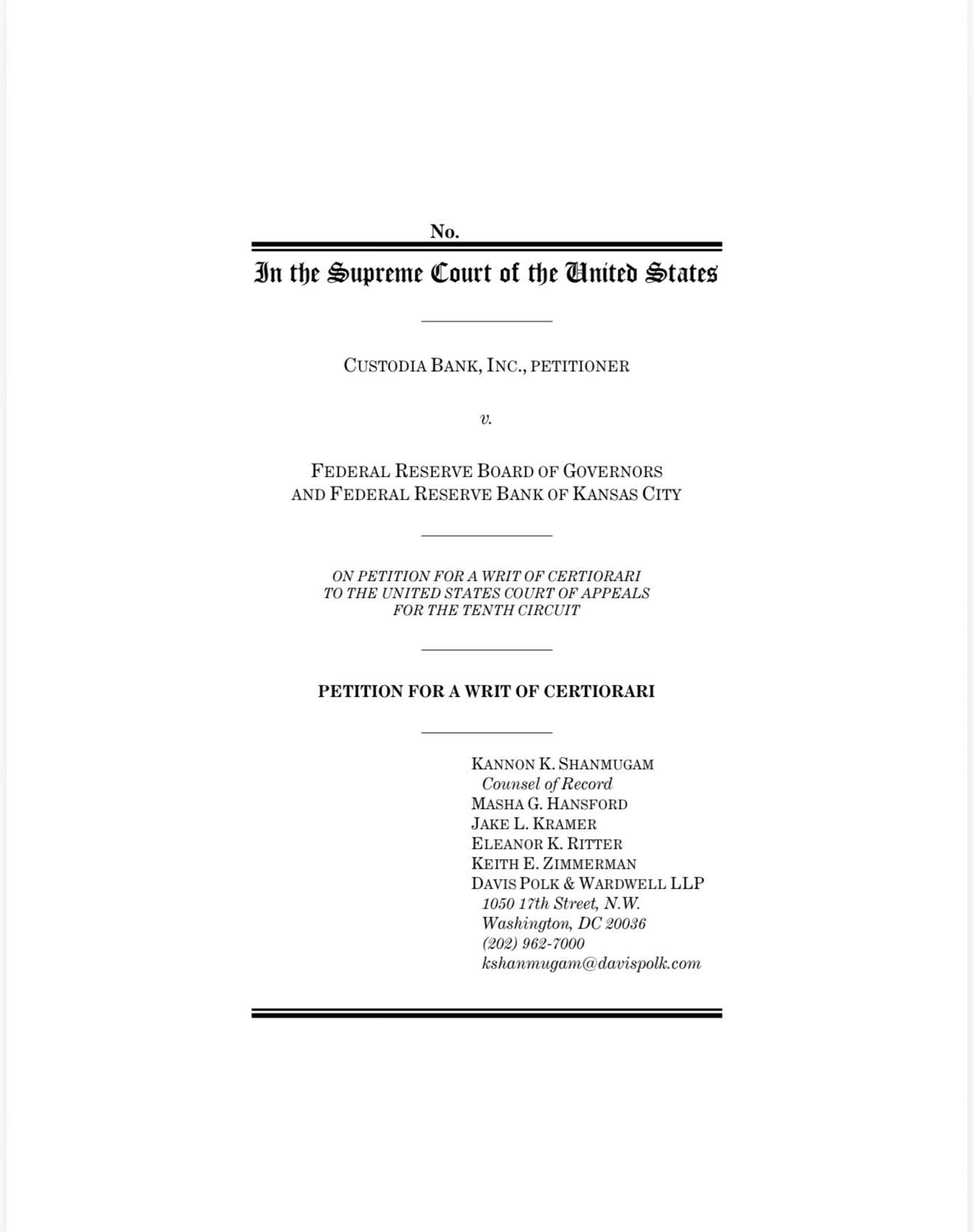
The filing is the latest escalation in Custodia CEO Caitlin Long's years-long fight with the Kansas City Federal Reserve, which denied the bank a master account in 2023. It comes after both a Wyoming federal district court and a divided Tenth Circuit panel sided with the Fed's interpretation of the Monetary Control Act, finding the central bank has broad discretion to deny master accounts.
Long did not respond to a request for comment.
According to the petition, reviewed by Crypto In America, the Kansas City Fed based its denial on concerns over Custodia's crypto-centric business model, a move many in the crypto industry have long pointed to as a defining example of "Operation Choke Point 2.0," a term critics use to describe what they believe was a coordinated effort by banking regulators to limit crypto companies' access to the financial system.
Whether the Supreme Court agrees to hear the case remains to be seen. The Court accepts only a small fraction of the thousands of petitions it receives each year. But if it does, the outcome could help define the limits of the Federal Reserve's discretion over master accounts and provide much-needed clarity for innovative state-chartered banks seeking access to the U.S. financial system.
👀 What To Watch This Week

Monday
The House and the Senate are back in session.
5:25 a.m.: The Fed’s Vice Chair for Supervision Michelle Bowman speaks at a roundtable hosted by Bank Policy Institute on modernizing financial regulation.
12:30 p.m.: Fed Governor Christopher Waller will give a speech on the economic outlook at the New York Association for Business Economics.
Tuesday
8:30 a.m.: The Bureau of Labor Statistics releases the June Consumer Price Index (CPI).
10:00 a.m.: Federal Reserve Chairman Kevin Warsh will testify on the semi-annual monetary report before the House Financial Services Committee.
12:30 p.m.: The Fed will host its semi-annual “Next-Gen Financial Inclusion” Conference with speeches from Governors Barr and Cook on artificial intelligence and Vice Chair for Supervision Bowman on responsible innovation.
Wednesday
BlackRock (BLK) reports earnings before the opening bell.
8:30 a.m.: The BLS will release the June Producer Price Index (PPI).
10:00 a.m.: Warsh will testify before the Senate Banking Committee. Office of Management and Budget Director Russ Vought will give the semi-annual report on the state of the Consumer Financial Protection Bureau to the House Financial Services Committee.
1:00 p.m.: Fed Governor Lisa Cook will give a speech on the economic outlook.
2:00 p.m.: The Federal Reserve will release its Beige Book, a snapshot of economic conditions across the country based on anecdotal reports from businesses and regional Fed banks.
Thursday
8:30 a.m.: The Census Bureau will release June retail sales data, offering a closely watched snapshot of consumer spending and the overall strength of the U.S. consumer.
10:00 a.m.: Injective kicks off its Summit in Washington, D.C., bringing together policymakers, lawmakers, and industry CEOs. Crypto In America will be on the ground covering the event.
7:00 p.m.: Federal Reserve Vice Chair Philip Jefferson will deliver remarks in Stanford, California, on navigating economic shocks.
Friday
10:00 a.m.: The House Financial Services Committee will hold a field hearing in New York City on how the Clarity Act unlocks innovation.
10:00 a.m.: The University of Michigan releases its preliminary consumer sentiment for July.
Crypto compliance isn’t slowing teams down anymore. It’s becoming a growth lever.
Sumsub is the identity verification and compliance platform trusted by 4,000+ companies, including 8 of the 10 largest crypto exchanges.
Their free State of the Crypto Industry 2026 report covers how the industry has shifted into a regulated maturity era: smarter fraud, higher expectations, and a new playbook for teams that want to scale. Inside: how to balance friction and conversion, where Travel Rule gaps remain, and why verification is now a competitive edge, not a checkbox.
Data from 4M+ fraud attempts and 300+ crypto companies surveyed. See how your peers are adapting here.
Weekend News Flash

ICYMI: The biggest headlines from Friday and the weekend.
A temporary ban on central bank digital currencies became law Friday at midnight when the Senate's Housing bill took effect after President Trump declined to sign the legislation in protest over the Senate's failure to pass the SAVE America Act.
The Federal Open Market Committee's meeting minutes showed inflation remains elevated, citing higher memory chip prices, tensions in the Middle East, and the impact of tariffs.
The Office of the Comptroller of the Currency granted Circle full approval to become a national trust bank after issuing conditional approval in December. Sony also received conditional approval to establish a U.S. trust bank, paving the way for its plans to issue a dollar-backed stablecoin.
The Federal Reserve appointed Andreessen Horowitz partner Marc Andreessen as an adviser to a new task force examining AI’s impact on productivity, jobs, and monetary policy.
Backpack launched 24/7 trading for tokenized U.S. equities on Solana, allowing international investors to trade tokenized shares of U.S. companies, including SpaceX, Micron, and SanDisk.
In a note, JPMorgan said Bitcoin faces a greater risk from blockchain adoption being hindered by permissioned infrastructure than from potential sales by Strategy.
Coinbase’s Chief Legal Officer, Paul Grewal, who led the company through its lawsuit with the Securities and Exchange Commission, will step down at the end of the month and move into an advisory role.
The White House pushed back on claims that it is dragging its feet on nominating Democrats to the vacant minority seats at the SEC and CFTC, saying Senate leadership did not respond to its request for a list of recommended candidates to fill the positions.
The CFTC stayed CME Group's self-certification for 24/7 crude oil futures pending further review, delaying the launch of the contract while the agency evaluates its compliance with federal law.
Remember: New editions of the Crypto In America newsletter drop every Monday and Thursday.
If you like what you’re reading, don’t forget to subscribe!
Still peddling bullsh*t for criminals I see. The end is near for this transnational espionage operation. Can’t wait to see the communications from the inside.