

Welcome to the Thanksgiving edition of the Crypto In America newsletter!
What you’ll read: The presidential memecoin dinner that’s raising questions (and eyebrows). The latest crypto policy updates from Washington and the week’s top headlines. A quick catch-up before you tuck into turkey or while you’re digesting on the couch.
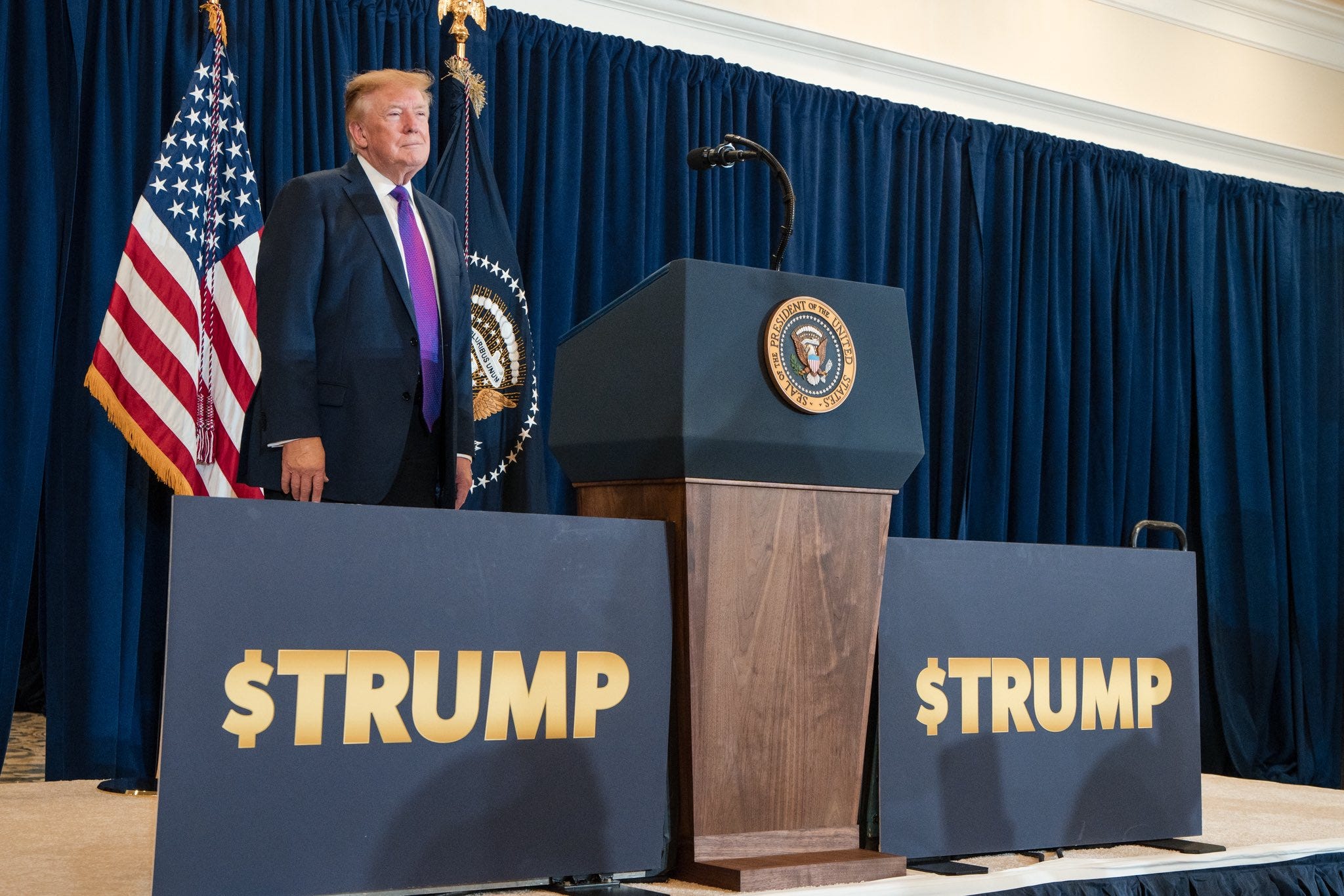
President Trump’s exclusive Sunday dinner for top holders of his battered memecoin is giving Democrats fresh ammunition as they prepare to investigate his crypto dealings next Congress.
“Trump’s flagrant crypto corruption persists at the expense of the people of this country, who just three weeks ago voted to root out corruption in DC,” said Rep. Maxine Waters (D-CA), the likely next chair of the House Financial Services Committee, in a Wednesday statement. “Trump’s gala dinner is a blatant effort to reward those funneling money to him and his family via the $TRUMP memecoin, granting exclusive access to the president in exchange for purchasing a worthless asset.”
As of this writing, $TRUMP is trading below $1, down roughly 99% from its peak of about $75. At Sunday’s dinner, the top 120 holders of the memecoin were eligible for gift bags with a Trump watch and fragrance, while the top four were eligible for 18-karat gold Trump watches. One attendee told NPR she saw some VIP guests take selfies with the president. Celebrity guests included boxing icon Floyd Mayweather and former NBA player Tristan Thompson.


The dinner raised questions about whether people overseas could gain access to the president by purchasing his memecoin. Consumer advocacy group Public Citizen found that at least 66 of the 130 wallets on the dinner’s leaderboard received $TRUMP directly from crypto exchanges that bar U.S. customers. Another attendee told NPR that most of the guests appeared to be from overseas.
“The first crypto bill our Committee must pass is to stop Trump’s crypto corruption,” Waters said.
The California Democrat introduced the Stop TRUMP in Crypto Act before Trump’s first memecoin dinner in May 2025. The bill seeks to restrict the president, vice president, members of Congress and their families from profiting from certain crypto activities while in office.
Over in the Senate, Richard Blumenthal (D-CT) said Trump had put a “‘For Sale’ sign on the White House,” while Patty Murray (D-WA) accused him of selling access to the presidency.
“Republicans have turned a blind eye to Trump’s shocking corruption. That ends next Congress,” Murray wrote on Bluesky.
Senate Banking Democrats Target SEC’s Approach to Crypto
Senators Elizabeth Warren (D-MA), who is expected to chair the Senate Banking Committee come January, and Chris Van Hollen (D-MD) each led a letter to SEC Chair Paul Atkins on Tuesday, arguing the agency overstepped its authority and put investors at risk through its efforts to regulate the crypto industry.
Warren’s letter, also signed by Van Hollen and Tina Smith (D-MN), urges the SEC to withdraw its “Reg Crypto” proposal, which would exempt certain crypto offerings from registration under the Securities Act of 1933. The senators warn that it could allow some issuers to raise money without giving investors even basic financial statements.
Van Hollen’s letter asks the SEC to scrap its innovation exemption, which lets eligible platforms trade tokenized stocks without registering as exchanges. Van Hollen, Warren, Smith and Jack Reed (D-RI) argue the exemption could make it harder for investors to get a fair price and easier for traders to manipulate prices.
The letter came a day after crypto exchange OKX and NYSE parent Intercontinental Exchange launched OKXICE, their platform for trading tokenized stocks under the exemption.

The SEC’s Investor Advisory Committee is set to take up the innovation exemption at its Dec. 3 meeting. Panelists will discuss the risks and benefits for investors and public companies and whether the SEC should revise it.
Business as Usual at the Regulators
Despite mounting scrutiny from Senate Democrats, staff at both agencies continue to clarify how existing rules apply to crypto.
On Monday, CFTC staff said derivatives trading platforms and clearinghouses can count bitcoin, ether and qualifying payment stablecoins toward the reserves they must hold to cover a year of operating expenses. Firms must count those assets at a discount and still need cash or highly liquid securities to cover near-term expenses.
Meanwhile, SEC staff issued a no-action letter to Molecule, a biotech platform where token holders can participate in research projects and separately apply for equity in the companies developing them. Based on the facts Molecule presented, staff said they would not recommend enforcement action if its subsidiary sells the tokens without registering the offering with the SEC.
News Flash

Bitcoin Reserve Bill Lands on the House Calendar. The House Financial Services Committee formally reported out Alaska Republican Rep. Nick Begich’s bill to establish a U.S. Strategic Bitcoin Reserve. The amended bill is now on the House calendar, but a floor vote before the end of the year is unlikely.
Kalshi Can Keep Taking Sports Bets in New York, for Now. A state judge declined New York Attorney General Letitia James’s request to shut down Kalshi’s sports markets in the state. The judge also asked both sides to discuss safeguards for traders under 21.
Kalshi Pauses Trading in Utah. The state asked a court to dismiss criminal charges against Kalshi and its co-founders after the company halted trading there on Monday. Utah Attorney General Derek Brown said he could refile the charges if Kalshi resumes trading in the state.
CFTC Makes Prediction Market Reporting Rules Permanent. The agency finalized rules on how platforms report trades in certain event contracts.
Bitcoin Miner CleanSpark Posts Nearly $1 Billion Loss. CleanSpark reported a $987 million net loss for fiscal 2026 as revenue fell 25% to $576.5 million. The company says the first part of its Georgia AI data center campus is on track to open in November 2027.
SALT Drops “Blockchain” From Its Wyoming Conference Name. Investment conference organizer SALT is renaming its flagship crypto event from the Wyoming Blockchain Symposium to the Wyoming Frontier Forum in 2027.
Jensen Huang Heads to the Hill. Fresh off his return as Nvidia CEO, Huang is scheduled to testify before the Senate Banking Committee next Thursday, Dec. 3, amid heightened scrutiny of the Trump administration’s role in his reinstatement.
DOJ Seeks $1.1 Billion From Binance Hack. The Justice Department asked a federal court in Washington to order the forfeiture of more than $1.1 billion in crypto that prosecutors say North Korean hackers stole from Binance last month.
Investors Pull Another $570 Million From Bitcoin ETFs. Investors pulled a net $570 million from U.S. spot bitcoin ETFs on Monday, bringing November’s net outflows to about $4.7 billion.

Thank you so much for reading and subscribing to Crypto In America. I’m grateful you’re here!
— Eleanor
Remember: New editions of the Crypto In America newsletter drop every Monday and Thursday.
If you like what you’re reading, don’t forget to subscribe!
So the criminals now are gonna clean out the corruption in Washington DC? If that ain’t a hoot and a half.