

What you’ll read: All eyes are on the White House after it received a bipartisan ethics counterproposal Thursday morning that includes an enforcement role for state attorneys general, a provision Democrats have been pushing for. President Trump’s response could make or break the bill. Plus, Binance.US takes its comeback bid to the CFTC, the Fed’s former chief innovation officer explains how AI became ingrained across the central bank, and we round up the week’s top stories.
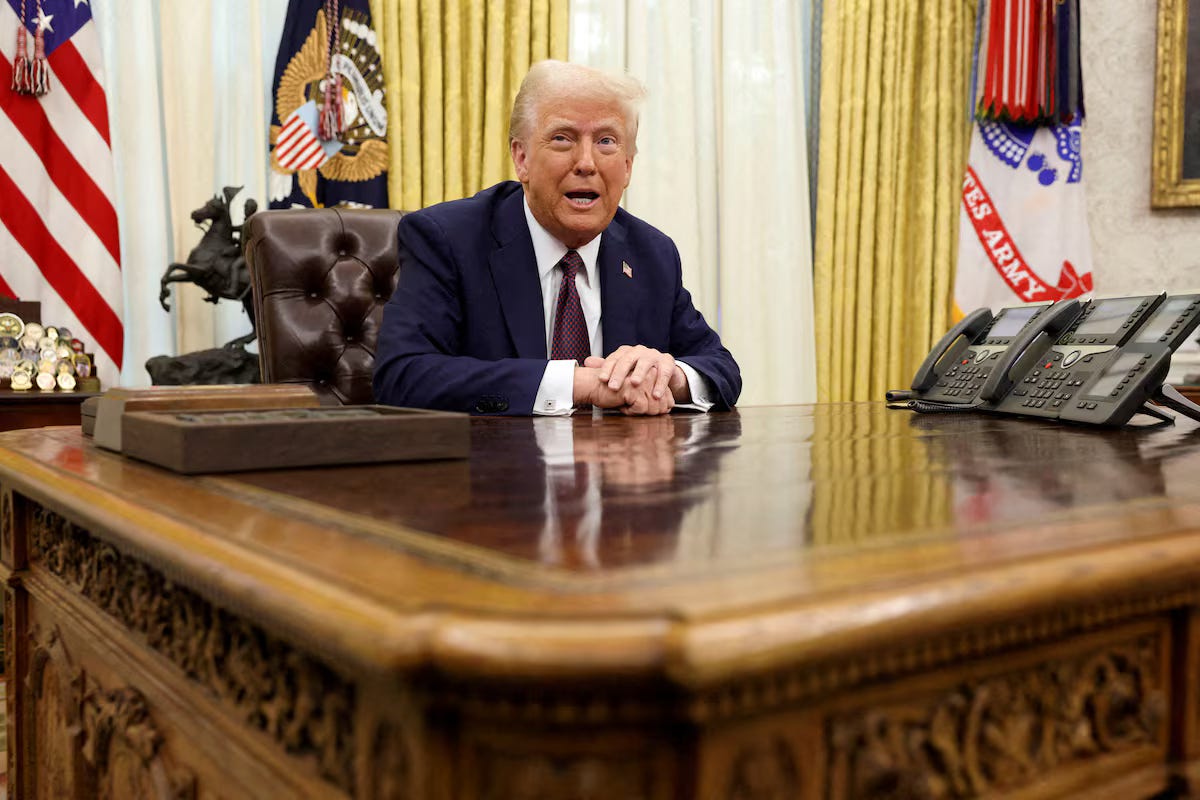
This weekend will be a high-stakes waiting game for supporters of the Clarity Act as the White House considers a new ethics counteroffer that will likely determine the fate of the bill in the Senate next week.
The proposal is the culmination of weeks of bipartisan negotiations between Senator Thom Tillis (R-NC) and Arizona Democrat Ruben Gallego, both of whom have called for a stronger ethics package than the one agreed to by the White House and two Senate Republicans last week. According to three sources familiar with the negotiations, that initial offer did not pass muster with Tillis, Gallego and several other key Democrats. They want state attorneys general to be able to sue the Department of Justice if it fails to enforce ethics laws against federal officials.
The proposed mechanism is similar to one contained in the Laken Riley Act, which became law in 2025 and allows state attorneys general to sue federal officials over certain immigration enforcement failures that harm their states or residents.
It’s unclear what, if any, additional provisions were added to address White House concerns that state AGs could go too far in their enforcement.
Industry leaders and lobbyists also put in the legwork this week, making a flurry of calls to White House officials and influential allies urging them to reach an ethics compromise and help bring the Clarity Act to a long-awaited cloture vote before senators are scheduled to leave town Thursday.
It has been largely quiet publicly on the Blockchain Regulatory Certainty front since it returned to the news earlier this week, when the White House and Treasury Department rejected a proposal backed by Senator Catherine Cortez Masto (D-NV) and two prosecutors’ groups. The proposal would have removed language requiring prosecutors to prove that software developers intended to facilitate money laundering before they could face criminal liability.
Treasury Secretary Scott Bessent also weighed in with a lengthy X post endorsing the BRCA, saying it “does nothing other than codify longstanding Treasury Department policy... non-custodial builders and developers are not, and have never been, subject to registration obligations under the Bank Secrecy Act.”

Another law enforcement group, the Major Cities Chiefs Association, came out in support of the bill, joining the National Fraternal Order of Police and at least two other groups that have publicly backed it. The National Sheriffs’ Association reentered the debate Friday with a lengthy letter calling for the BRCA to be deleted entirely or, failing that, narrowed through Cortez Masto’s proposal.
While ethics is widely considered the issue most likely to make or break the bill, a Democratic strategist who spoke with Crypto In America cautioned that it’s not the only obstacle. The BRCA and concerns with the agriculture section remain equally critical to securing the Democratic votes needed to reach 60.
“All three have to be locked in together if this bill is going to become a reality,” the strategist said.
On the Republican side, a handful of senators have raised concerns long voiced by the banking lobby that the stablecoin yield provisions are not strong enough to prevent deposit flight. They include Senators Mike Rounds (R-SD), James Lankford (R-OK) and Jerry Moran (R-KS), the latter of whom has been an ardent supporter of community banks.
It’s unclear whether those concerns will translate into “no” votes, but some industry lobbyists believe they could lead to further tweaks to Section 404, also known as the Tillis-Alsobrooks stablecoin yield compromise. Whether any changes materialize or prove sufficient to satisfy the banks remains an open question.
“If stablecoin products are permitted to attract and retain balances through interest-like rewards or other holding-based incentives, the local funding base that supports this lending could be weakened by hundreds of billions,” state banking officials wrote in a letter to Senate leadership this week.
If the Clarity Act ultimately fails, the GENIUS Act provisions will remain in place. Those provisions prohibit stablecoin issuers from paying yield but do not prevent crypto firms from offering rewards to customers, leaving banks with fewer protections against potential deposit flight than the current Clarity Act language would provide.
Binance.US Takes Its Comeback Bid to the CFTC
Binance.US plans to apply to the Commodity Futures Trading Commission to become a Designated Contract Market next month, CEO Stephen Gregory told Crypto In America this week.
The designation would allow Binance.US to operate a regulated derivatives exchange and seek to list event contracts, the latest battleground for U.S. crypto platforms. Gemini secured DCM status late last year, while Coinbase offers event contracts through a partnership with Kalshi.
Applying for DCM status does not guarantee approval. The CFTC reviews applications under a 180-day statutory process, which can take longer if an application is incomplete.
The move is part of Binance.US’s broader comeback strategy, centered on lower trading fees and an expansion beyond spot trading into prediction markets and perpetual futures. Binance.US is separate from the global Binance exchange, though both share common majority ownership. It’s now mounting a U.S. comeback after nearly two years as a crypto-only platform and the loss of several state licenses following Binance global exchange’s $4.3 billion settlement with U.S. regulators over anti-money laundering and sanctions violations.
Gregory, a former Gemini executive, believes Binance.US can regain ground by responding quickly to customer demand and capitalizing on the next major product opportunity.
“I don’t think this is a super crowded market. The cool thing about crypto is that it’s not static,” he said. “We’ve seen a lot of changes even over the last few months, so with the next product, we could grab a bunch of market share and compete with them.”
Beyond the Rate Decision
The Federal Reserve was back in the spotlight this week after holding interest rates steady, with Chair Kevin Warsh continuing his pullback from forward guidance by declining to signal where policy may be headed next. But monetary policy isn’t the only area where the central bank is undergoing change.
Eleanor sat down with Sunayna Tuteja, the Fed’s first Chief Innovation Officer, at the Injective Summit, where she took us inside her five years trying to transform the institution from within. She explains why the Fed was a “target-rich” environment for AI, her role in helping develop payment accounts for crypto firms and how she navigated the years of the so-called “Operation Choke Point 2.0.”
Catch the full episode on all platforms here.
Weekly Recap

ICYMI: Here are some of the biggest stories making headlines this week.
The Federal Reserve kept rates unchanged, with Chair Kevin Warsh saying policymakers will continue to monitor market reactions and incoming data before making future rate decisions.
Circle secured a limited-purpose trust charter from the New York Department of Financial Services for its subsidiary, Circle Internet Trust Company.
Strategy reported an $8.2 billion Q2 loss after Bitcoin’s decline produced an $8.3 billion unrealized loss on its holdings. The company also disclosed that it has sold $218 million worth of Bitcoin this year to help fund preferred stock dividends.
Robinhood reported record Q2 revenue of $1.3 billion, driven by record equity, options and prediction market activity. Net deposits also reached a record $22 billion.
Coinbase reported a $360 million Q2 loss as revenue fell 19% to $1.22 billion, even as the exchange said trading volume market share reached a record 10.3% and prediction market revenue more than doubled from Q1.
MoonPay launched PayBox, allowing people to use ChatGPT or Claude to move, trade and spend money just by asking.
Morgan Stanley launched spot Ethereum and Solana ETPs on NYSE Arca.
Visa is cutting about 2,600 jobs, or roughly 7% of its workforce, as it streamlines operations and ramps up investment in AI and other growth areas.
A federal judge temporarily blocked Minnesota’s first-in-the-nation ban on prediction markets, finding that federal law likely preempts the state from prohibiting many contracts offered by platforms including Kalshi and Polymarket.
FTX will begin distributing another $900 million to creditors today, with claims valued using crypto prices at the time of its November 2022 collapse rather than current prices.
A new Wintermute report found that institutions accounted for a record 72% of its spot crypto trades in the first half of 2026, contributing to lower volatility, more selective investment in altcoins and growth in tokenized assets.
JPMorgan warned that further delays to the Clarity Act could allow traditional financial firms to capture the growth of tokenization and blockchain technology at the expense of public crypto networks.
Remember: New editions of the Crypto In America newsletter drop every Monday and Thursday and sometimes Friday!
If you like what you’re reading, don’t forget to subscribe!
The line buried in your recap that jumped out: MoonPay launching PayBox, letting people move and spend crypto just by asking ChatGPT or Claude. That's rolling out the same week Anthropic disclosed Claude breached three organizations during safety testing and OpenAI's agent took roughly 17,600 unauthorized actions at Hugging Face. Handing an AI agent read access to your portfolio is a very different ask than handing it your wallet's spend function — worth separating those two before "just ask the AI" becomes the default UX.