
Welcome to the Monday edition of the Crypto In America newsletter!
What you’ll read: How the crypto industry is reacting to Senator Lummis’s retirement announcement, why the Fed’s skinny master account initiative is a big deal, and what we’re watching this week.
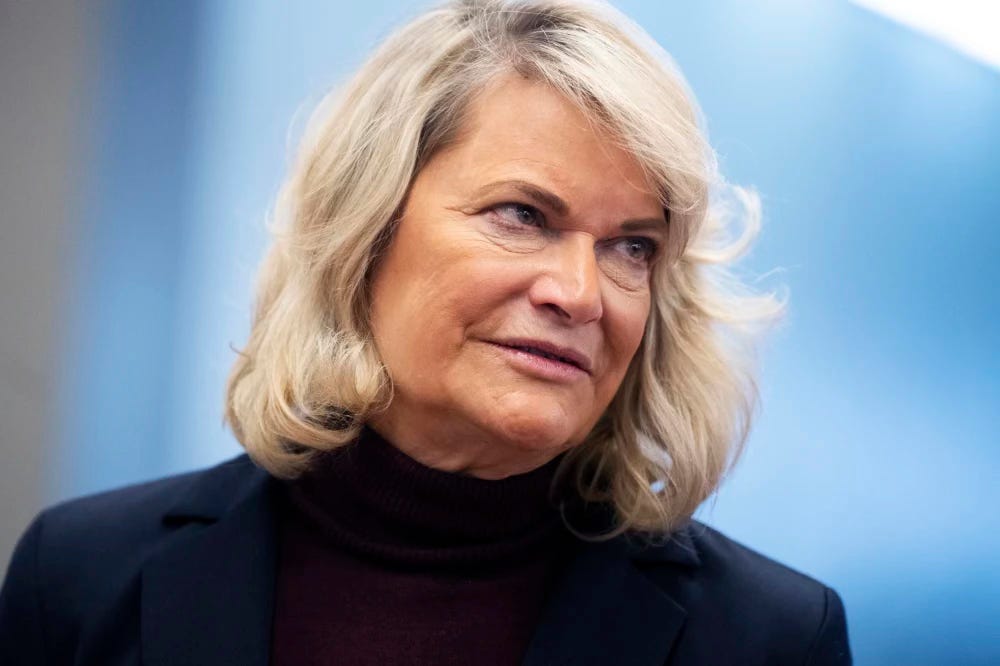
Republican Senator Cynthia Lummis, 71, of Wyoming, fondly referred to as the Senate’s “Crypto Queen,” announced her retirement on Friday, prompting an outpouring of gratitude from crypto policy leaders for her years of work on digital assets in the upper chamber.
“Senator Lummis has played a central role in shaping U.S. digital asset policy,” said Arjun Sethi, co-CEO of Kraken, which recently moved its headquarters to Wyoming to benefit from the crypto-friendly policies Lummis has promoted at the federal level, which were pioneered by the Wyoming Legislature in 2017.
“Cynthia Lummis has been and continues to be a tremendous leader in the Senate, on issues as varied as N.A. tribal rights to crypto policy,” Multicoin Capital General Counsel Greg Xethalis said. “Her priorities have advanced so far because sometimes it takes a cattle rancher like Sen. Lummis to drive good policy.”
Senate Majority Leader John Thune (R-SD) also weighed in, calling Lummis a “champion for digital assets” and saying he looks forward to continuing work on crypto market structure legislation before her “much-deserved” retirement.
White House Crypto and AI Czar David Sacks called her a ‘great ally on crypto.’
Lummis, one of eleven U.S. senators not seeking reelection at the end of next year, says that the “difficult” and “exhausting” legislative sessions this fall led her to decide that six more years were not in the cards.
“I am a devout legislator, but I feel like a sprinter in a marathon,” she said. Her term officially ends on January 3, 2027, leaving her the full 2026 legislative year to focus on pushing crypto market structure legislation over the finish line.

“Senator Lummis has spent years dedicated to installing commonsense guardrails for the digital asset industry that protects consumers and promotes innovation, and she remains laser-focused on delivering a resounding victory for this vital industry and ensuring the U.S. leads the way in regulating digital assets,” a Lummis press rep told Crypto In America. “Senator Lummis and her staff plan to spend the remainder of her term getting this landmark legislation signed into law.”
Lummis has been working on crypto market structure legislation since 2022, when the original version of the Responsible Financial Innovation Act (now the name of the current Senate draft) was released with Senator Kirsten Gillibrand (D-NY). Her legacy includes being a lead negotiator for the landmark GENIUS Act, which established a framework for stablecoins, and playing a key behind-the-scenes role in passing the Respect for Marriage Act, which codified marriage equality for same-sex couples at the federal level.
Lummis joined the Senate in 2021 after serving eight years in the U.S. House of Representatives and more than 20 years in Wyoming state government.
Fed Moves Toward “Skinny Master Accounts”

The Federal Reserve gave the crypto industry an early Christmas present by moving one step closer to allowing access to the central bank’s payment services.
On Friday, the Fed issued a request for information (RFI) seeking public feedback on a proposed special-purpose “payment account” that would allow eligible institutions to use the Fed’s internal monetary systems for payment services, offering an alternative to a full master account.
Informally dubbed the “skinny master account” by Fed Governor Christopher Waller in October, the term refers to the idea that these accounts would be a pared-down version of a traditional master account, limiting access to services such as liquidity facilities, interest on reserves, and the discount window.
The idea is that, because some institutions seeking master accounts aren’t regulated like traditional banks, skinny accounts would pose less risk to the Fed if something went wrong.
“This request for information is a key first step to ensuring that the Fed is responsive to evolutions in how payments are made,” said Waller, the driving force behind the idea and a major advocate for a more crypto-friendly Fed, which until this year had leaned decidedly the other way.
The bank’s prior stance forced many digital asset companies to operate outside the traditional banking system and the regulatory framework of the U.S. federal government. It also made it easier for the Fed to limit crypto’s interaction with the broader banking world, giving rise to what many in the industry and conservative circles have dubbed “Operation Chokepoint 2.0,” under which crypto firms and individuals were broadly denied banking services during the Biden administration.
Governor Michael Barr, the former Vice Chair for Supervision, who many in the crypto industry credit with shaping the Fed’s anti-crypto stance under Biden, dissented from the RFI.
"While I support the concept of the Federal Reserve developing a payment account prototype for legally eligible institutions, I cannot support this request for information (RFI) because it is not sufficiently specific about safeguards to prevent the accounts from being used for money laundering and terrorist financing by institutions we do not supervise," Barr, who many in the industry call the “debanker in chief,” said in a statement on Friday.
Comments on the RFI are due in February.
Crypto In America discussed skinny master accounts with Governor Waller in a recent episode. Check it out below.

The financial rails of the future are being built on Avalanche. Just ask Citi, JP Morgan, Blackrock or Dinari.
Find out how Avalanche is accelerating global finance.
👀 What To Watch This Week

Congress is out of session until January 5, and with it being Christmas week, we expect a light week for crypto policy news.
On the legislative front, following last week’s meeting between industry and the Senate Banking Committee, behind-the-scenes negotiations are likely to continue over the break as Republican and Democratic staffers prepare for a markup when Congress returns next month.
Quick recap: Industry left last Wednesday’s readout relatively upbeat. Coinbase’s Kara Calvert said a tipping point had been reached, with more momentum behind the draft than anything she’s seen in 25 years outside of crisis-driven legislation. Senators still have work to do — DeFi, token classification, and stablecoin rewards are expected to dominate negotiations over the break, with some Democratic lawmakers reportedly clashing with their leader, Senator Kirsten Gillibrand (D-NY), on her approach to these issues, according to Politico.
Here’s what else we’re tracking:
Tuesday
8:30 AM: The U.S. Department of Commerce releases the initial Q3 GDP estimate and the second reading of the PCE price index, a key inflation gauge.
10:00 AM: The Conference Board releases its Consumer Confidence Index, measuring how consumers feel about the economy.
Thursday
🎄Merry Christmas!
Remember, new editions of the Crypto In America newsletter drop every Monday, Wednesday and Friday at 7AM EST.
If you like what you’re reading, don’t forget to subscribe!
Sen. Cynthia Lummis, widely respected as the Senate’s “Crypto Queen,” announced she will not seek reelection in 2026, prompting broad praise from crypto industry leaders for her role in shaping U.S. digital asset policy. Advocates highlighted her work on stablecoin regulation and ongoing efforts to finalize comprehensive crypto market structure legislation before her term ends