
Welcome to the Monday edition of the Crypto In America newsletter!
What you’ll read: Crypto regulators are moving ahead on a handful of initiatives as the Clarity Act awaits Senate action. Plus, what to watch this week, former New York Governor Andrew Cuomo sits down with Crypto In America at SALT Wyoming, and the weekend headlines you may have missed.
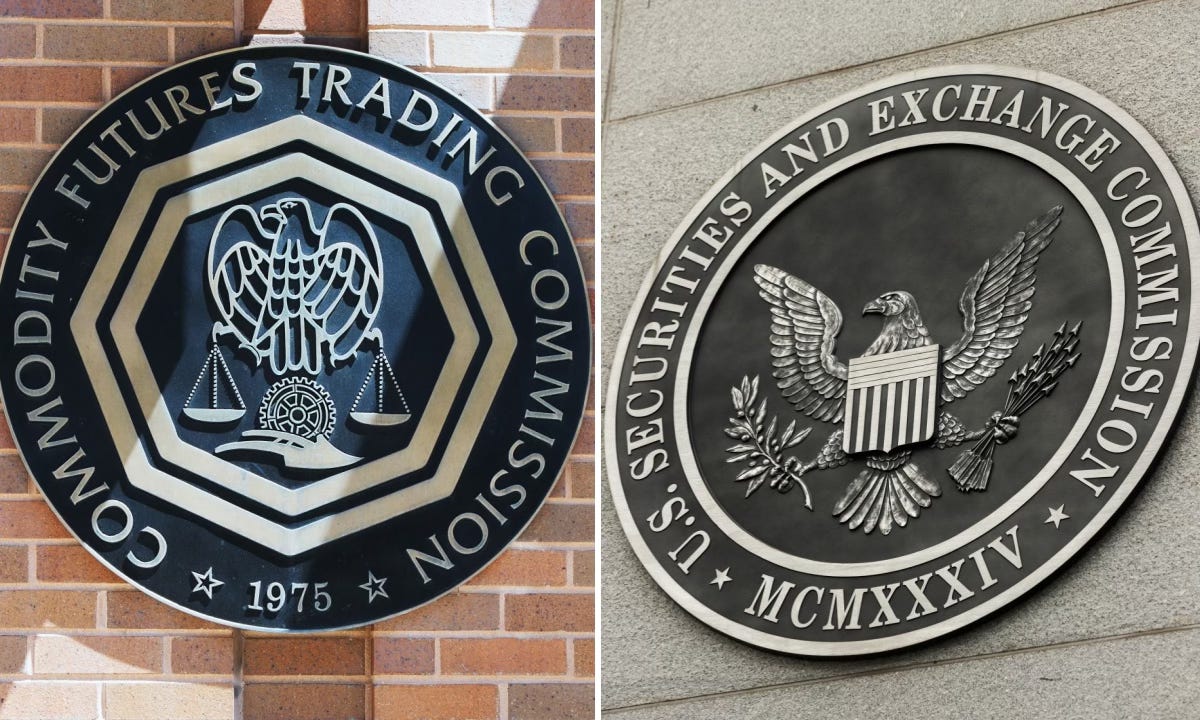
While crypto market structure legislation sits in summer recess limbo, the SEC and CFTC are getting a head start on writing the rules for the $2.5 trillion industry.
Both agencies are pressing ahead with several crypto-related initiatives, including a fresh look at derivatives and a rewrite of the SEC’s crypto custody rules.
First up: Derivatives.
In June, the agencies asked for public input on how swaps, security-based swaps and novel or emerging products should be defined and where SEC and CFTC jurisdiction should begin and end.
Now, a bipartisan group of former SEC and CFTC officials is weighing in, warning that getting those lines wrong could continue driving lucrative markets overseas.
In a new comment letter, former CFTC Chairman Chris Giancarlo, former CFTC Commissioners Brian Quintenz and Sharon Brown-Hruska, former SEC Commissioner Steven Wallman and former SEC Chief Economist Chester Spatt argue that similar risks should face similar regulatory treatment and overlapping rules shouldn’t pile on additional compliance costs.
The bipartisan makeup is notable at a time when neither agency has bipartisan representation. The signatories argue these aren’t inherently partisan questions, pointing to longstanding common ground between commissioners of both parties on protecting investors and keeping U.S. markets competitive.
The issue is particularly relevant for crypto as the CFTC looks to bring perpetual futures onshore, a market some signatories have individually argued U.S. regulation has largely driven overseas. Earlier this month, President Trump said CFTC Chairman Michael Selig is working to bring popular offshore perps platform Hyperliquid into the United States.
On Monday, Bloomberg reported that Payward, the parent company of Kraken, is in talks with the Singapore-based platform to bring some of its perpetual futures contracts to U.S. traders.
Prediction market platform Kalshi, which began offering crypto perps earlier this year, estimates offshore perpetuals trading topped $90 trillion in 2025, up from around $28 trillion two years earlier. Kalshi sponsored the letter by retaining law firm Bellementis PLLC to help with drafting, though the signatories say they weren’t compensated and the company had no say over its contents. Quintenz, one of the letter’s signatories, is also a member of Kalshi’s Board of Directors.
The core message: regulation can push trading elsewhere, but it doesn’t make the demand or the risk disappear. And time is of the essence.
“The $90 trillion offshore perpetuals market isn’t a mystery to solve, it’s a market waiting for a sensible U.S. rulebook,” Giancarlo told Crypto In America. “If we calibrate federal regulation to actual risk instead of maximum burden, that liquidity comes onshore. Every year we wait, it gets harder to bring to America.”
Over at the SEC, custody is back in focus.
Last week, the SEC sent a planned rewrite of its custody rules for investment advisers and investment companies to the White House Office of Information and Regulatory Affairs (OIRA) for review.
The planned rule is expected to tackle a question the crypto industry has sought clarity on for years: How can SEC-regulated investment firms provide custodial services for digital assets while complying with federal securities laws? This is particularly relevant for investment advisers, which are required to use “qualified custodians” which meet strict standards for safeguarding and accounting related to customer assets.
The text isn’t public yet, so details on which firms could qualify as crypto custodians or what requirements they would have to meet remain unclear. What is clear is that the SEC says it wants to clarify the rules around crypto custody while stripping out provisions it considers outdated.
That marks a notable change in direction from the agency’s previous attempt to tackle the issue three years ago, when then-Chairman Gary Gensler proposed a sweeping “safeguarding” rule that would have expanded existing adviser custody requirements beyond funds and securities to virtually all client assets, including crypto.
The Atkins SEC scrapped that proposal last year.
Meanwhile, the SEC’s “Reg Crypto” proposal, which would establish new rules for certain crypto asset offerings, has officially hit the Federal Register and is open for public comment until October 20.
👀 What To Watch This Week

Monday
The House is back in session. The Senate is out.
Tuesday
Crypto exchange Kraken is set to liquidate remaining balances of 21 delisted assets through Saturday after withdrawals closed on August 27.
9:05 a.m.: Federal Reserve Governor Michael Barr speaks on the economic outlook and financial inclusion.
Wednesday
10:00 a.m.: The House Financial Services Committee will hold a hearing titled “Strengthening the American Economy: Promoting Growth, Opportunity, and Prosperity.”
Thursday
8:30 a.m.: Federal Reserve Governor Christopher Waller speaks on the economic outlook.
Friday
8:30 a.m.: Jobs Friday: The Bureau of Labor Statistics will release its August jobs report, including the unemployment rate.
Crypto compliance isn’t slowing teams down anymore. It’s becoming a growth lever.
Sumsub is the identity verification and compliance platform trusted by 4,000+ companies, including 8 of the 10 largest crypto exchanges.
Their free State of the Crypto Industry 2026 report covers how the industry has shifted into a regulated maturity era: smarter fraud, higher expectations, and a new playbook for teams that want to scale. Inside: how to balance friction and conversion, where Travel Rule gaps remain, and why verification is now a competitive edge, not a checkbox.
Data from 4M+ fraud attempts and 300+ crypto companies surveyed. See how your peers are adapting here.
Is New York the Crypto Capital?
ICYMI: We sat down with former New York Governor Andrew Cuomo at the SALT Wyoming Conference for a conversation about the future of crypto in the Big Apple. Cuomo, who oversaw New York’s early crypto regulations, says the state and the U.S. as a whole need clearer rules to keep pace with other jurisdictions, calling the Clarity Act critical to giving the industry a path forward.
The former NYC mayoral candidate, now a board member of crypto exchange OKX, called the remaining issues surrounding the legislation political rather than substantive, arguing that “if it’s not resolved, they’re not resolving it because they want it for political benefit.” He also reflected on New York’s BitLicense, saying its initial intent was right but that the regulatory regime became overly restrictive over time in response to a multitude of scandals.
Catch the full episode on all platforms here.
Weekend News Flash

ICYMI: Here are some of the biggest headlines from Friday and the weekend.
Fed Chair Kevin Warsh’s hawkish Jackson Hole remarks sent markets lower Friday as traders ramped up bets on another interest rate hike. Short term Treasury yields and the dollar rose while stocks and crypto fell, with Bitcoin dropping from around $80,000 to below $77,000. Bitcoin dipped below $77,000 again Monday morning before rebounding.
A federal appeals court ruled that Kalshi cannot block Nevada from regulating its sports event contracts, handing state gaming regulators a win in the ongoing fight over prediction markets. The Ninth Circuit found Kalshi had not shown that federal commodities law preempts Nevada’s gaming laws, creating a split with the Third Circuit that could tee the issue up for the Supreme Court.
The CFTC ordered a former White House teleprompter operator to pay more than $172,000 after finding he used advance access to President Trump’s speeches to profit from Kalshi “mention markets.” Perez agreed to return roughly $108,000 in profits, pay a $65,000 penalty and accept a three-year trading ban.
Bitwise’s Solana Staking ETF (BSOL) crossed $1 billion in assets under management, becoming the first individual Solana ETF to hit the milestone just 10 months after its launch.
Charles Schwab announced plans to add Solana, Avalanche and Chainlink to its crypto trading platform in the coming months, expanding its direct crypto offering beyond Bitcoin and Ethereum.
The Crypto.com-linked Cronos blockchain halted on Sunday following an exploit of lending protocol Tectonic that an onchain researcher estimates affected roughly $75 million in assets. Crypto.com CEO Kris Marszalek said the company’s app and exchange were not compromised.
Cosmos Labs said a vulnerability in its Cosmos EVM software was exploited across six blockchains, with attackers converting stolen tokens into roughly $5.7 million in assets. The company acknowledged that the flaw had been reported through its bug bounty program in April but was incorrectly determined not to put live networks at risk.
Advocacy group Public Citizen estimated that investors across five Trump-linked crypto products are at least $4.7 billion underwater, largely reflecting unrealized losses, while estimating that Trump earned at least $1.4 billion from crypto ventures in 2025.
Tornado Cash developer Roman Storm’s retrial on money laundering and sanctions charges has been pushed to April 2027 at his request, while his motion for acquittal remains pending.
Remember: New editions of the Crypto In America newsletter drop every Monday and Thursday!
If you like what you’re reading, don’t forget to subscribe!
The custody rulemaking angle here is the one to watch — Gensler's 2023 "safeguarding" rule tried to fold crypto into standard custodian rules and got shelved, and now the Atkins SEC is rewriting it from scratch with the text still not public. Worth asking who that rule actually protects: CertiK counted $444.5 million lost to wallet compromise in H1 2026 alone, and none of that belonged to anyone with a "qualified custodian." Institutional custody keeps getting clearer while the self-custody crowd is still on their own.
The key takeaway is that tokenization alone doesn't guarantee efficient price discovery. When liquidity, redemption, and arbitrage mechanisms are limited, on-chain prices can diverge dramatically from the underlying asset. As tokenized markets grow, understanding the structure behind the token will be just as important as understanding the asset itself.