
Welcome to the Monday edition of the Crypto In America newsletter!
What you'll read: Clarity Act negotiations continue this week as ethics remains the biggest hurdle and Democratic calls to rein in President Trump's crypto business interests grow. Plus, what to watch this week and the top stories shaping crypto policy and markets.
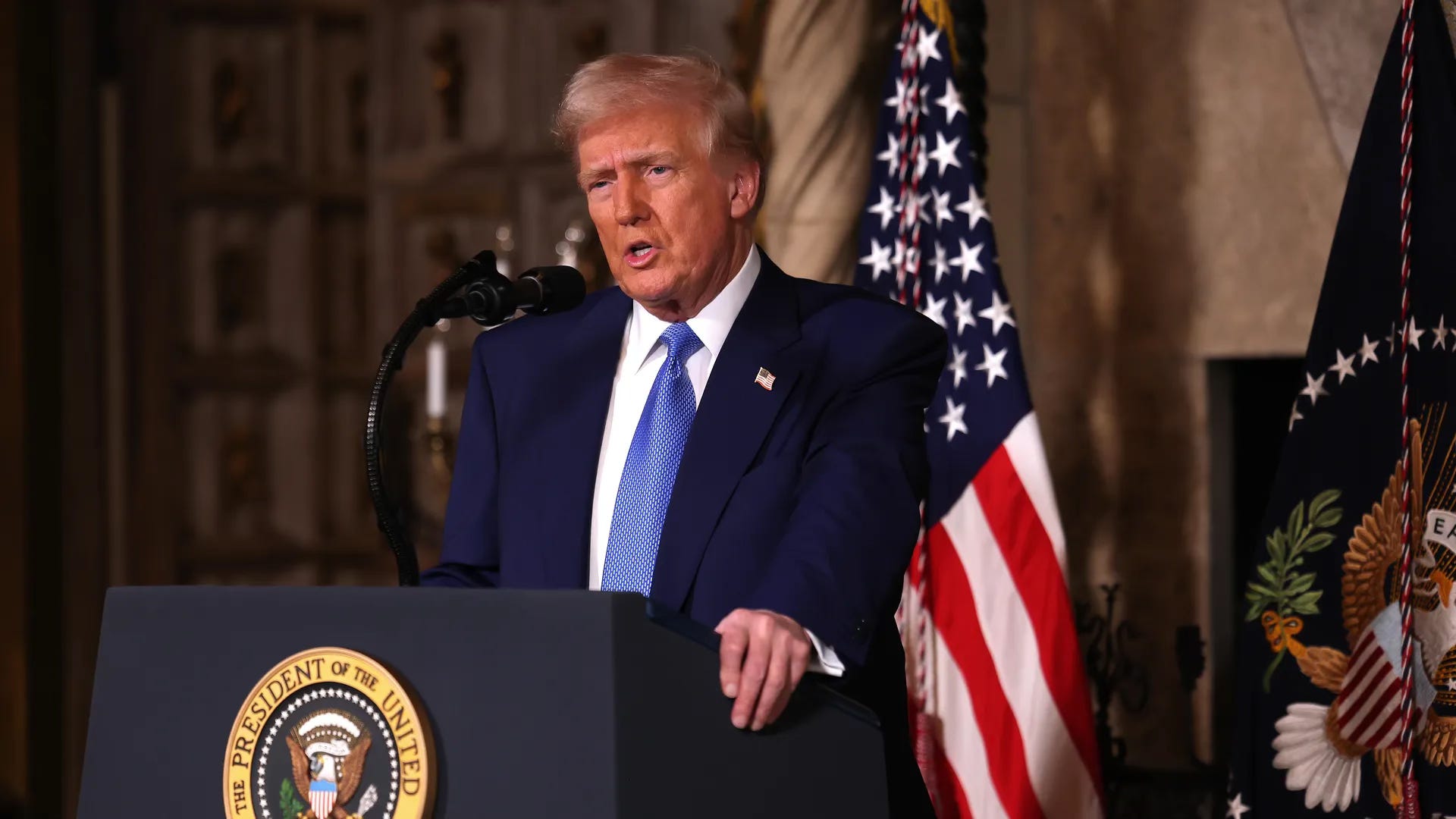
The White House’s target of signing the Clarity Act into law by July 4 has come and gone, and if you’ve been following Crypto In America’s reporting, you’ll know why that timeline was always a long shot.
With all eyes now on August 6 as the next deadline, little has emerged publicly to suggest meaningful progress toward resolving the handful of outstanding issues needed to bring the bill to the Senate floor as lawmakers enter the second week of recess.
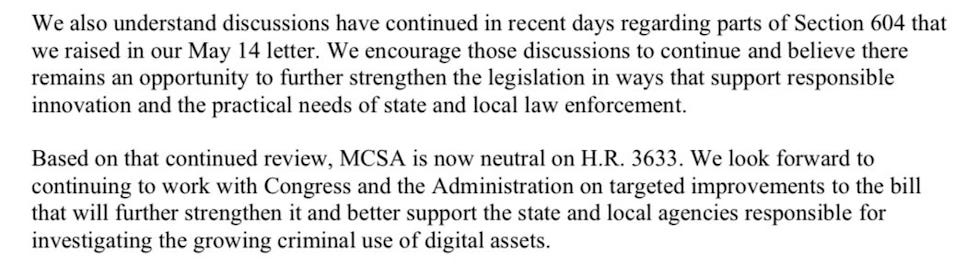
One notable exception has been the emergence of two letters from law enforcement organizations that have become key stakeholders in negotiations over the Clarity Act, both first reported by Crypto In America. The first, from the National Organization of Black Law Enforcement Executives (NOBLE), formally endorsed the legislation, while the second, from the Major County Sheriffs of America (MCSA), shifted to a neutral position, citing continued discussions with administration officials last week.
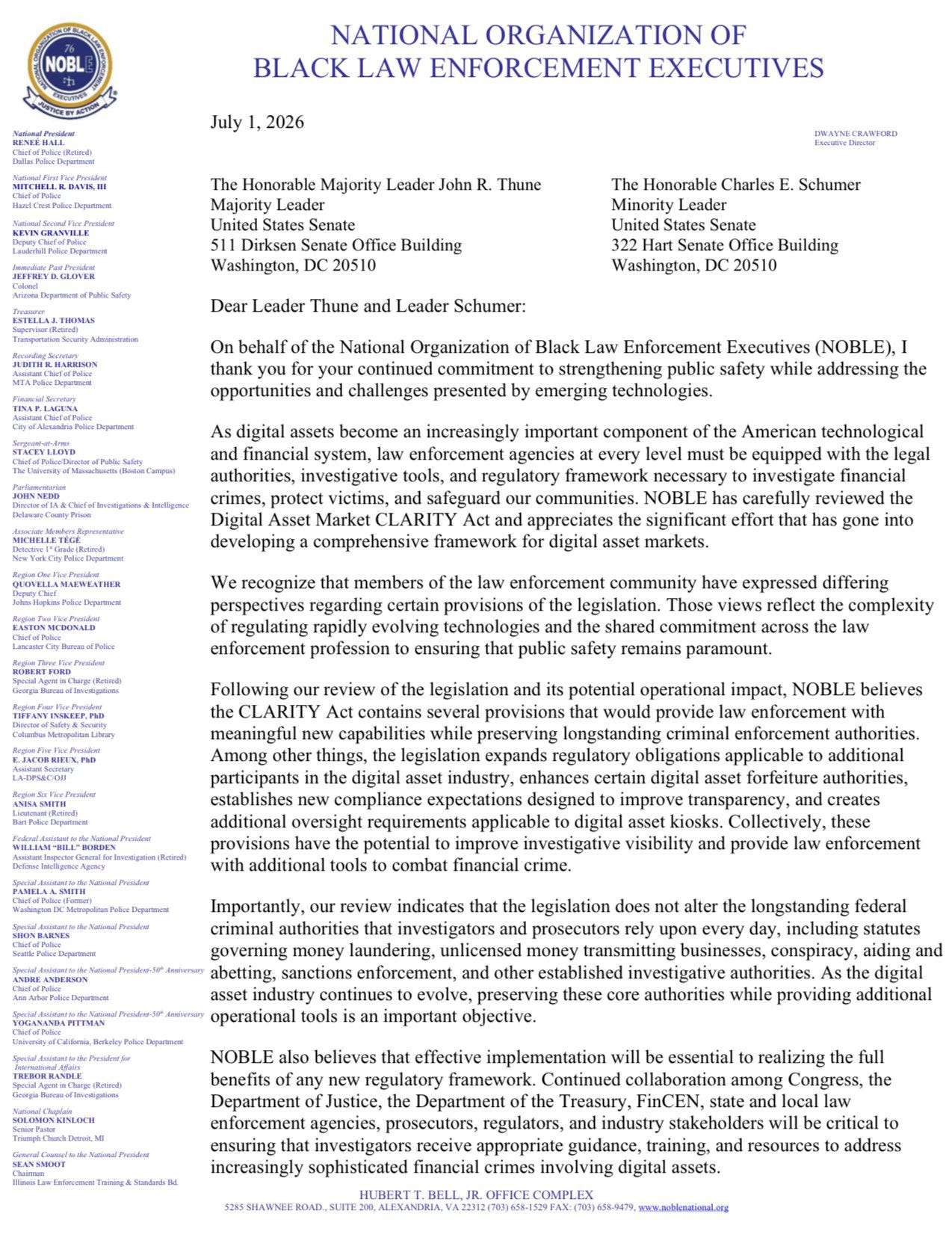
NOBLE also became the first major law enforcement organization to publicly back the Blockchain Regulatory Certainty Act, a section of the legislation that has become the primary sticking point for other law enforcement groups involved in the negotiations. Those groups argue the provision could create oversight gaps that criminal actors could exploit. NOBLE, however, said the bill “does not alter the longstanding federal criminal authorities that investigators and prosecutors rely upon every day,” including statutes governing money laundering and unlicensed money transmitting businesses.
MCSA, meanwhile, said its discussions with administration officials presented an opportunity to “further strengthen the legislation in ways that support responsible innovation and the practical needs of state and local law enforcement.” That suggestion has raised concerns among some industry leaders that the BRCA section, which many view as essential to securing support from the crypto industry, could ultimately be watered down to win broader law enforcement support.
Elsewhere, no agreement has yet emerged on ethics provisions as political pressure continues to build following President Trump’s financial disclosures, which revealed he generated more than $1 billion in crypto-related income last year, including more than $600 million from his TRUMP memecoin.
That pressure was evident on Friday, when Senator Kirsten Gillibrand (D-NY) renewed her call for ethics rules prohibiting the president, members of Congress, and their spouses from issuing or sponsoring digital assets. The proposal drew pushback from some industry leaders, including BitGo CEO Mike Belshe, who argued any ethics rules should apply equally across all asset classes because the problem is politicians' conduct, not crypto itself.


Gillibrand’s latest push also comes amid scrutiny following reports that her son, Theodore, has raised funding to launch a perpetual futures exchange. The platform is not expected to involve crypto or blockchain technology, according to those reports, although it counts Ripple co-founder Chris Larsen among its backers.
Senators Ruben Gallego (D-AZ) and Angela Alsobrooks (D-MD), the two Democrats who voted to advance the Clarity Act out of the Senate Banking Committee in May and have said their continued support hinges on a strong ethics agreement being reached before a Senate floor vote, have also reacted sharply to President Trump’s financial disclosures.
“Trump is using the presidency to profit off the American people,” Gallego wrote in a post on X. “I’ll keep doing everything I can to crack down on his corrupt crypto dealings.” Alsobrooks told reporters that Trump and his family are “the most corrupt we’ve ever seen in the White House,” adding that an ethics provision is “desperately needed.”
Negotiations are expected to continue this week ahead of lawmakers returning from recess on July 13. If consensus is reached on the remaining issues, the Clarity Act could be brought to the Senate floor as soon as the week of July 20.
👀 What To Watch This Week

Monday
Eric Trump and Donald Trump Jr.'s Bitcoin mining company, American Bitcoin (ABTC), will continue trading on the Nasdaq after a 1-for-15 reverse stock split reduced its outstanding shares from roughly 1.09 billion to about 73 million.
Tuesday
SpaceX (SPCX) is set to join the Nasdaq 100 Index.
Wednesday
2:00 p.m.: The Federal Open Market Committee will release the minutes from its June meeting, giving investors a closer look at policymakers' thinking on interest rates, inflation and the economy.
3:00 p.m.: The Federal Reserve publishes its consumer credit report, which measures how much Americans are borrowing outside of mortgages.
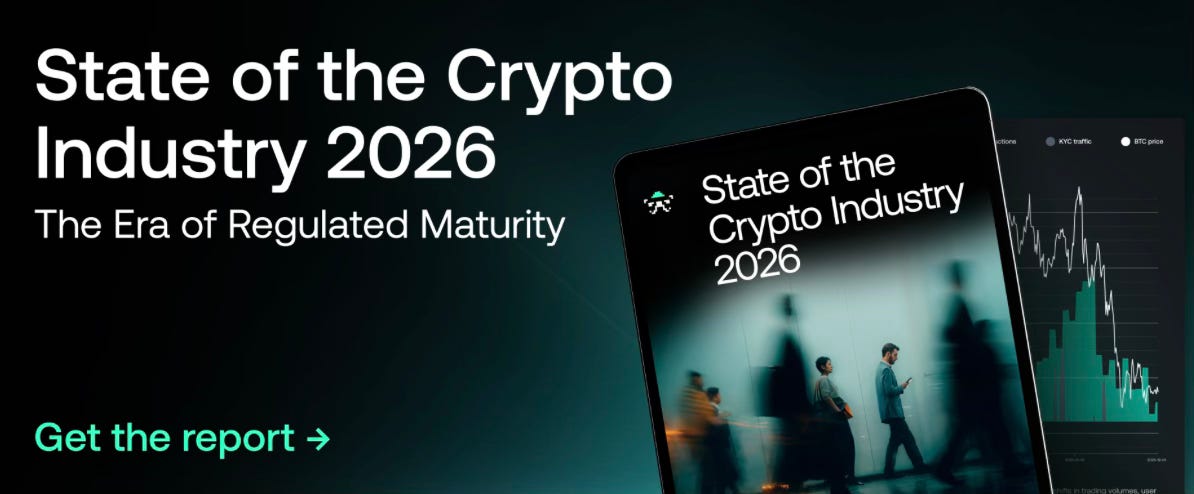
Crypto compliance isn’t slowing teams down anymore. It’s becoming a growth lever.
Sumsub is the identity verification and compliance platform trusted by 4,000+ companies, including 8 of the 10 largest crypto exchanges.
Their free State of the Crypto Industry 2026 report covers how the industry has shifted into a regulated maturity era: smarter fraud, higher expectations, and a new playbook for teams that want to scale. Inside: how to balance friction and conversion, where Travel Rule gaps remain, and why verification is now a competitive edge, not a checkbox.
Data from 4M+ fraud attempts and 300+ crypto companies surveyed. See how your peers are adapting here.
Weekend News Flash

ICYMI: The biggest headlines from Friday and the weekend.
Michael Saylor’s Strategy sold 3,588 BTC for approximately $216 million to fund distributions on its preferred stock and replenish the U.S. dollar reserves used to make those payments. The move marks a dramatic step up from last month’s sale of just 32 bitcoin.
Tom Lee’s BitMine Immersion purchased 42,197 ETH, worth roughly $74 million, lifting its ETH holdings to about $10 billion.
Tokenization platform Securitize debuted on the NYSE under the ticker SECZ while simultaneously tokenizing $295 million worth of its own shares.
Stablecoin transaction volume hit a record $1.79 trillion in June, up 63% from May, according to Visa.
Remember: New editions of the Crypto In America newsletter drop every Monday and Wednesday.
If you like what you’re reading, don’t forget to subscribe!
The August 6 deadline is the part people are underrating. If this slips past recess, reconciling the Banking and Ag Committee texts becomes the real bottleneck, not the ethics fight everyone's watching. Gillibrand's push on the $TRUMP disclosures gives Democrats cover to keep withholding cloture votes, so the timeline probably drifts again. The law enforcement endorsement helps optics but doesn't move the seven votes that matter.