
Welcome to the Wednesday edition of the Crypto In America newsletter!
What you’ll read: Is debanking still an issue for the crypto industry? Plus, the week’s top stories and Aave Labs founder joins the podcast.

Debanking is back in focus this week after a prominent crypto CEO said the U.S.’s largest bank abruptly closed all of his accounts.
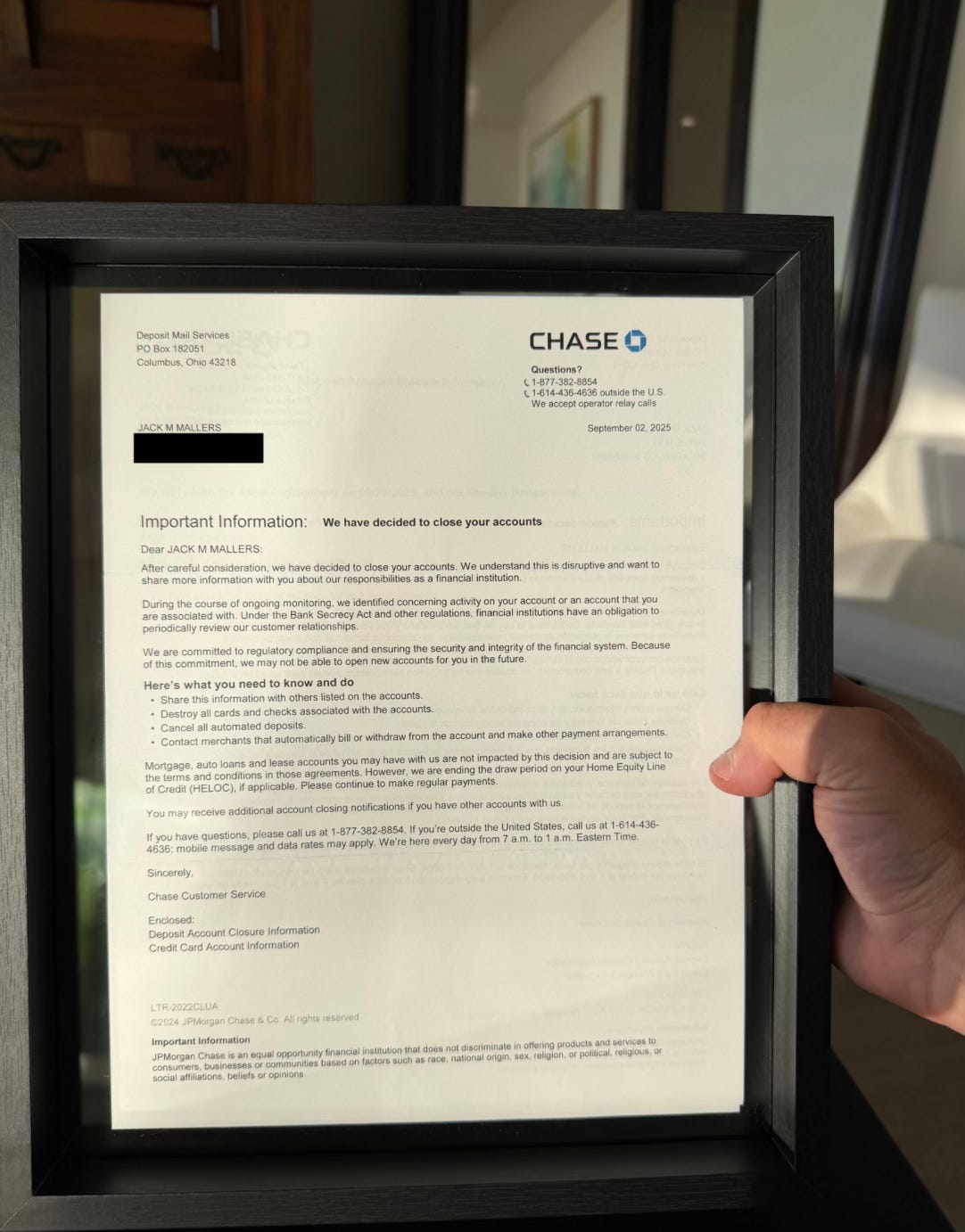
Jack Mallers, CEO of Bitcoin payments company Strike, took a tongue-in-cheek approach after JPMorgan informed him in a September 2 letter that it was closing his accounts over undisclosed “concerning activity,” posting a photo of the framed notice on X.
‘A proud moment. So proud I got it framed,’ Mallers quipped in response to Tether CEO Paolo Ardoino, who said he thought JPMorgan’s decision to drop Mallers as a client was ‘for the best.’
Others were less amused. Wyoming Senator Cynthia Lummis blasted JPMorgan on X, saying Operation Chokepoint 2.0 ‘regrettably lives on,’ a campaign that industry figures and some lawmakers describe as a coordinated effort by former regulators and the Biden administration to squeeze crypto out of the banking system.
A JPMorgan spokeswoman declined to comment on the Mallers incident but stressed that the bank serves crypto companies across the industry.
The move comes as the Trump administration pushes to crack down on debanking, following an August executive order that bans cutting off lawful crypto businesses and directs regulators to punish politically motivated account closures.
While it remains unclear why Mallers’ account was closed, a source close to the bank explained that legacy systems, which combine automated monitoring with human review to flag potential anti-money laundering issues, tend to favor account closure over preservation, reflecting a long-standing culture of ‘erring on the side of caution.’
“The system is currently designed to incentivize prudence around AML,” the source said, noting that Mallers’ situation may not have been specific to crypto.
However, Mallers also said JPMorgan has allegedly rejected some deposits to Strike, telling customers the business ‘participates in fraudulent activities,’ suggesting a broader pattern of discrimination against the Bitcoin payments app.
Why this matters: While JPMorgan still reserves the right to make decisions about individual banking relationships, the revelations have raised concerns that banks may continue discriminatory practices against the crypto industry. They are also fueling renewed calls to reform the current Anti-Money Laundering/Combating the Financing of Terrorism reporting regime, which many view as outdated and prone to uneven treatment of clients and industries.
“Debanking will not stop unless the Bank Secrecy Act and global AML/CFT frameworks are drastically overhauled…” said independent journalist Lola Leetz.
Treasury officials have called for a modernized, risk-based approach that targets high-risk behavior instead of applying a one-size-fits-all approach to AML/CFT reporting.

Invest as you spend with the Gemini Credit Card®. Get approved to earn $200 in Bitcoin. Issued by WebBank. Terms apply.
Midweek Recap

It’s only Wednesday of a holiday week, but things are moving fast. Here’s a rundown of the top stories:
After a modest crypto rebound this week, JPMorgan says digital assets are emerging as a ‘tradable macro asset class.’
Binance was sued by dozens of families of victims of the October 7 Hamas attack on Israel. The lawsuit, filed in a North Dakota court, claims the exchange helped move roughly $1 billion to Hamas and its allies before and after the attack.
Texas bought $5 million of BlackRock’s bitcoin ETF, $IBIT, as a first step toward building a state bitcoin reserve.
The SEC issued a no-action letter to Solana-based DePin project Fuse Energy, confirming its token offerings are not securities. The agency said the tokens’ value comes from their use within the network, not from investor profits.
CFTC Acting Chair Caroline Pham asked for CEO nominations for a new innovation council that will help advise on rules for crypto market structure and prediction markets.
MoonPay secured a Limited Purpose Trust Charter from New York’s financial regulator, NYDFS, giving it the green light to offer crypto custody and OTC trading in the state.
Bitwise’s new Dogecoin ETF launches today on NYSE Arca under the ticker $BWOW. It follows the rollouts of Franklin Templeton’s XRP ETF ($XRPZ) and Grayscale’s Dogecoin ($GDOG) and XRP ($GXRP) ETFs earlier this week.
Polymarket secured CFTC approval to operate fully as an exchange for U.S. retail users and brokerages.
U.S. Bank, the nation’s fifth-largest bank, is testing the issuance of bank-grade stablecoins on the Stellar blockchain.
Klarna, the Swedish buy-now-pay-later company, is rolling out a dollar-backed stablecoin on a new payments blockchain from Stripe and Paradigm.
Anchorage Digital launched a program offering rewards for holders of USDtb and USDe stablecoins, providing potential insight into how the OCC may approach GENIUS Act rulemaking.
Aave’s Stani Kulechov on DeFi’s Next Chapter
This week on the podcast, we air our on-stage interview from SmartCon with Aave Labs founder Stani Kulechov. As one of the leading DeFi protocols on Ethereum, Aave lets users lend, borrow, and earn interest on crypto without banks. We discuss how Aave is blending traditional finance into DeFi with things like token buybacks, and why making financial access global remains Kulechov’s driving mission.
He also weighs in on the SEC’s approach to DeFi, why tokenization is the future, and how teams should navigate today’s market volatility.
Watch this episode on all platforms here.
Remember, new editions of the Crypto In America newsletter drop every Monday, Wednesday and Friday at 7AM EST.
If you like what you’re reading, don’t forget to subscribe!