
Welcome to the Monday edition of the Crypto In America newsletter!
What you’ll read: The Senate punted a key procedural vote on the Clarity Act to September. How it happened, what comes next and why regulators are preparing to move ahead with crypto rules of their own. Plus, what we’re watching this week and the headlines making news.
There was light at the end of a dark week for the crypto industry when Majority Leader John Thune (R-SD) filed cloture on the motion to proceed to the Clarity Act in the early hours of Saturday morning, putting the bill on the Senate’s floor schedule when lawmakers return from August recess.
The filing likely tees up a key procedural vote for the afternoon of September 15, the day after the Senate reconvenes for a short three-week session before the midterms.
As Crypto In America reported Friday afternoon, Thune’s staff had told industry leaders to expect the filing before the Senate adjourned. Some characterized the move as a gesture of good faith meant to show that the Clarity Act remains a priority after the industry and the bill’s Republican champions were left angry and disappointed by news Thursday night that leadership would leave Washington without scheduling a long-awaited cloture vote.
“You all know me and how long and hard I’ve fought for this bill, so you can imagine how frustrated I am,” Senator Cynthia Lummis (R-WY), the sponsor of the Senate version of the Clarity Act, said in a Friday statement. Lummis and her GOP colleagues had predicted the bill would be included among the Senate’s crowded slate of priorities before lawmakers departed for recess. Thune himself had said he expected it to get a vote, though he acknowledged the timing was uncertain.
So what happened?
It depends who you ask. By week’s end, the blame game looked something like the Spider-Man meme, with three Spider-Men pointing at one another: Republicans blamed Democrats for refusing to compromise and dragging out the process, Democrats blamed the White House for not coming to the table to negotiate a more palatable ethics agreement, and the White House blamed Democrats for rejecting the package already on offer.

Another Spider-Man for the banks would also be fitting. Their campaign to convince senators that the bill’s safeguards against stablecoin-driven deposit flight are insufficient has gained traction in recent weeks, with at least two Republican senators signaling that they are not prepared to support the Clarity Act as written.
The bill’s proponents have responded by blasting the banking lobby for slowing its progress. Sens. Lummis and Bernie Moreno (R-OH) went a step further Friday, signing on as co-sponsors of the bipartisan Credit Card Competition Act, joining Sens. Roger Marshall (R-KS), Peter Welch (D-VT) and Dick Durbin (D-IL).
Banks fiercely oppose the measure because it targets their swipe-fee revenue and, they warn, could force them to scale back credit card rewards. The move was widely read as a shot across the bow from Lummis and Moreno over the banking industry’s efforts to delay Clarity.


But amid all the finger-pointing, most crypto policy wonks agree on one thing: Without a bipartisan ethics agreement, the bill likely lacked the 60 votes needed to advance, raising fears on both sides that it would fail at the first procedural hurdle. That gave Democrats leverage to keep negotiations going. Punchbowl News reported that they insisted on more time, warning that forcing a vote without a deal could kill the broader effort.
“Chuck Schumer got what he wanted,” one legislative aide said of the Senate minority leader. “He managed to keep all the Fairshake money on the sidelines for now.”
Fairshake and its affiliates recently reported nearly $129 million in combined cash on hand. With no vote, the industry’s biggest super PAC network lacks a fresh roll call to guide its general election spending, likely putting major commitments on hold until at least September. As one industry source put it, “That leaves the industry with plenty of frustration but no obvious target for its political firepower.”
What’s Next?
Senators will be back in their respective states for the next five weeks. By most accounts, Hill staffers, lobbyists and industry leaders are planning to take a breather before getting back to work.
“I think everyone’s going to wait to see if there’s any ethics movement,” Cody Carbone, CEO of the crypto trade association Digital Chamber, said. “We plan to keep doing what we’ve been doing for the next month, but everyone is sort of in ethics limbo right now.”
Reaching a deal everyone can live with on President Trump’s crypto dealings will undoubtedly remain the biggest hurdle, but further negotiations over the Blockchain Regulatory Certainty Act and the commodities portion of the bill are also expected, according to two sources close to the talks. It remains to be seen whether any changes will be made to the bill’s stablecoin yield provisions to win over Republicans wary of being forced to choose between the crypto industry and community banks.
Senator Thom Tillis (R-NC) told reporters Friday that he thought the bill’s odds of passage would “drop precipitously” as the midterm elections approach.
As of Friday, the White House had not publicly responded to the bipartisan ethics counteroffer put forward by Tillis and Ruben Gallego (D-AZ). The proposal would give state attorneys general a role in enforcing the ethics rules and, according to Bloomberg, require President Trump to divest from crypto-related business interests.
Trump told Punchbowl News that he didn’t oppose placing his family’s crypto businesses in a blind trust but objected to being singled out by the proposed ethics language.
“In the bill, they want me to be different than everyone else,” he said.
Regulatory Relief on the Horizon?
As Senate staff spend at least part of the August recess pursuing bipartisan compromises on the bill’s outstanding issues, the crypto regulators are expected to remain active as well.
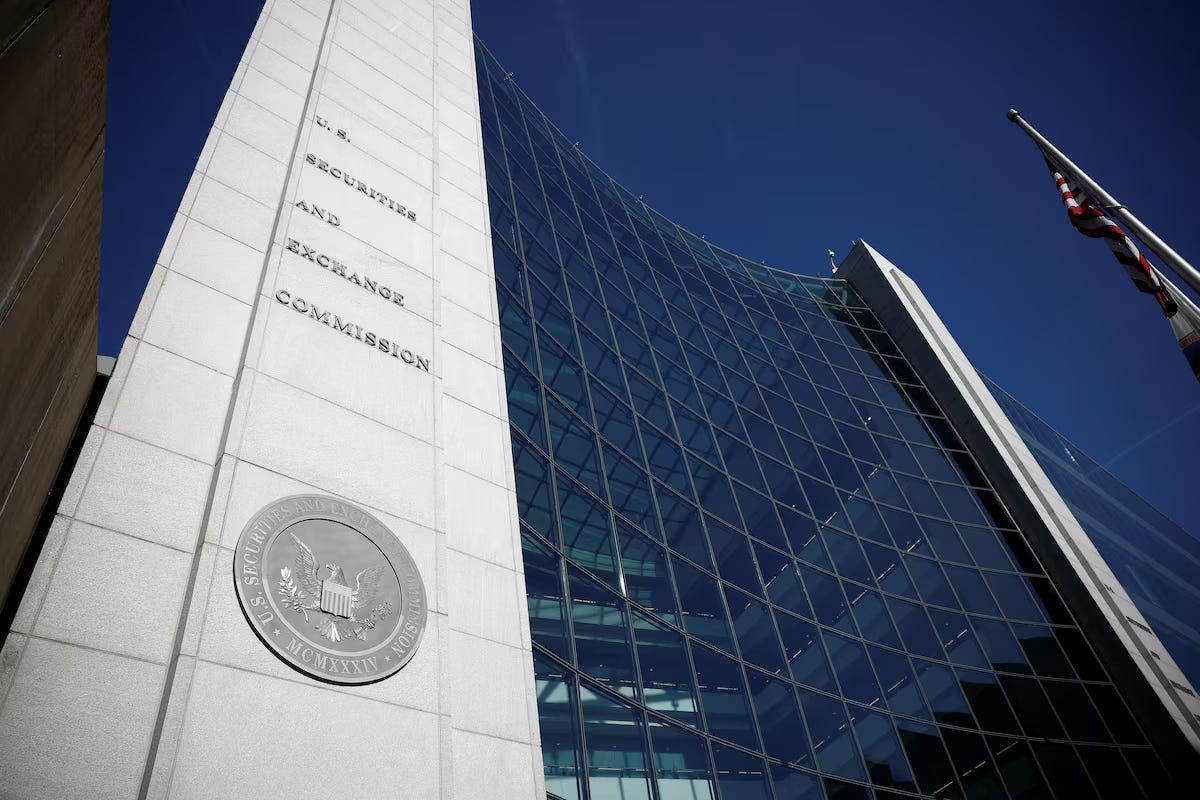
The Securities and Exchange Commission announced Monday that it will hold an open meeting on August 14 to consider proposing a tailored offering regime for certain investment contracts involving crypto assets, a vote that could formally launch the rulemaking process.
The notice identified the proposal as Regulation Crypto Assets, one of the agency’s top crypto priorities, which is expected to create registration exemptions and safe harbors for certain crypto offerings.
According to a source familiar with the matter, the proposal would likely build on the SEC and CFTC’s March joint interpretation, which established a five-category token taxonomy and clarified when an investment contract involving a crypto asset begins and ends.
The source added that action on tokenized securities may also be coming. But the meeting notice does not mention the agency’s long-awaited tokenization innovation exemption, leaving its timing and path forward unclear. The SEC’s rulemaking agenda also includes proposals addressing asset custody and broker-dealer and transfer-agent rules for crypto.
Formal rulemaking is not the agency’s only avenue. The SEC has also issued guidance and no-action letters this year aimed at providing greater clarity and targeted relief.
SEC Chair Paul Atkins has outlined even broader ambitions for the agency, saying in May that it was considering rules governing onchain exchanges, brokers and dealers, clearing agencies and crypto vaults. He and fellow commissioners Hester Peirce and Mark Uyeda have repeatedly said they do not want to front-run Congress as lawmakers work to pass the Clarity Act. But with the bill’s prospects now uncertain, the agency’s calculus may be shifting.
The SEC did not immediately respond to a request for comment.
“[T]he work of bringing clear rules to digital assets isn’t waiting on Congress,” Coinbase Chief Policy Officer Faryar Shirzad wrote on X. “The Trump Administration’s financial regulators continue to use the authorities they have to provide greater clarity and enable responsible adoption of blockchain technology, while governments and financial institutions around the world are moving ahead as well.”
For its part, the CFTC announced Monday that its Innovation Advisory Committee will hold its inaugural meeting on August 20. The panel includes leaders from Coinbase, Ripple, Robinhood, Kraken, Gemini, Polymarket, Kalshi, CME, Nasdaq and other major crypto and traditional finance firms.
👀 What To Watch This Week

Monday
Bitdeer (BTDR) and Sharplink (SBET) report earnings pre-market.
Trump Media & Technology Group (DJT), Bakkt (BKKT) and Exodus (EXOD) will report earnings after the closing bell.
Tuesday
eToro Group (ETOR) reports earnings before the opening bell. CoreWeave (CRWV) reports after the closing bell.
Wednesday
8:30 a.m.: The Bureau of Labor Statistics releases the July Consumer Price Index, a closely watched gauge of inflation.
Securitize (SECZ) reports earnings post-market.
Thursday
8:30 a.m.: The Bureau of Labor Statistics releases the July Producer Price Index, another closely watched inflation measure.
Gemini Space Station (GEMI) reports earnings after the closing bell.
Friday
8:30 a.m.: The Commerce Department releases its July retail sales report.
10:00 a.m.: The SEC will hold an open meeting to consider proposing tailored rules for certain crypto investment contracts.
The University of Michigan releases its preliminary consumer sentiment reading for August.
Crypto compliance isn’t slowing teams down anymore. It’s becoming a growth lever.
Sumsub is the identity verification and compliance platform trusted by 4,000+ companies, including 8 of the 10 largest crypto exchanges.
Their free State of the Crypto Industry 2026 report covers how the industry has shifted into a regulated maturity era: smarter fraud, higher expectations, and a new playbook for teams that want to scale. Inside: how to balance friction and conversion, where Travel Rule gaps remain, and why verification is now a competitive edge, not a checkbox.
Data from 4M+ fraud attempts and 300+ crypto companies surveyed. See how your peers are adapting here.
Weekend News Flash

ICYMI: Here are some of the biggest stories making headlines.
The Commodity Futures Trading Commission announced that its inaugural Innovation Advisory Committee meeting will take place on August 20.
Ethereum co-founder Vitalik Buterin has outlined an updated roadmap that makes quantum safety, stronger privacy and native rollups top priorities for the network.
Strategy sold 1,690 BTC for $108.6 million and used the proceeds to repurchase STRC preferred shares. The company separately raised $653 million through MSTR share sales, lifting its U.S. dollar reserve to $4.65 billion.
Exodus posted an $18.6 million Q2 net loss, swinging from a $37.7 million profit a year earlier.
Grayscale withdrew its S-1 registration statements for proposed Cardano, Hedera and Polkadot ETFs, according to SEC filings.
Trump Media, the parent company of Truth Social, is unwinding multiple deals with crypto exchange Crypto.com, including plans for a CRO-focused digital asset treasury company. The firm also disclosed that it held 14,139 BTC worth approximately $891 million as of July 31.
Crypto exchange Bybit is suing North Korea and the Lazarus Group over the $1.5 billion hack it suffered in 2025 and has secured a preliminary court order freezing certain identified stolen assets.
The U.S. economy lost 23,000 jobs in July, sharply missing expectations for an 80,000 gain, while the unemployment rate fell to 4.1%.
Crypto market maker Wintermute’s U.S. arm has registered as a broker-dealer, clearing the way for it to trade U.S. stocks and options for its own account and provide liquidity to crypto-linked ETFs.
Remember: New editions of the Crypto In America newsletter drop every Monday and Thursday.
If you like what you’re reading, don’t forget to subscribe!
Excellent newsletter. I love the way you give us all the up-to-date crypto news without any fluff. Good job!
Worth flagging: the SEC's own meeting notice doesn't attach a dollar figure to Friday's proposal, but CLARITY's Section 103 — also branded "Regulation Crypto" in the bill text — caps raises at the greater of $50M/year or 10% of an asset's value, up to $200M total. If the SEC's rule ships without matching numbers, projects get two different fundraising ceilings depending on which agency finishes first. Atkins not wanting to front-run Congress cuts both ways here — Congress is the one now running behind.