
Welcome to the Wednesday edition of the Crypto In America newsletter!
What you’ll read: Senator Angela Alsobrooks (D-MD) delivers a dose of realism on the stablecoin yield debate; the SEC drops more details on its CFTC harmonization plans; this week’s top stories; and Bridge co-founder Zach Abrams joins the podcast.
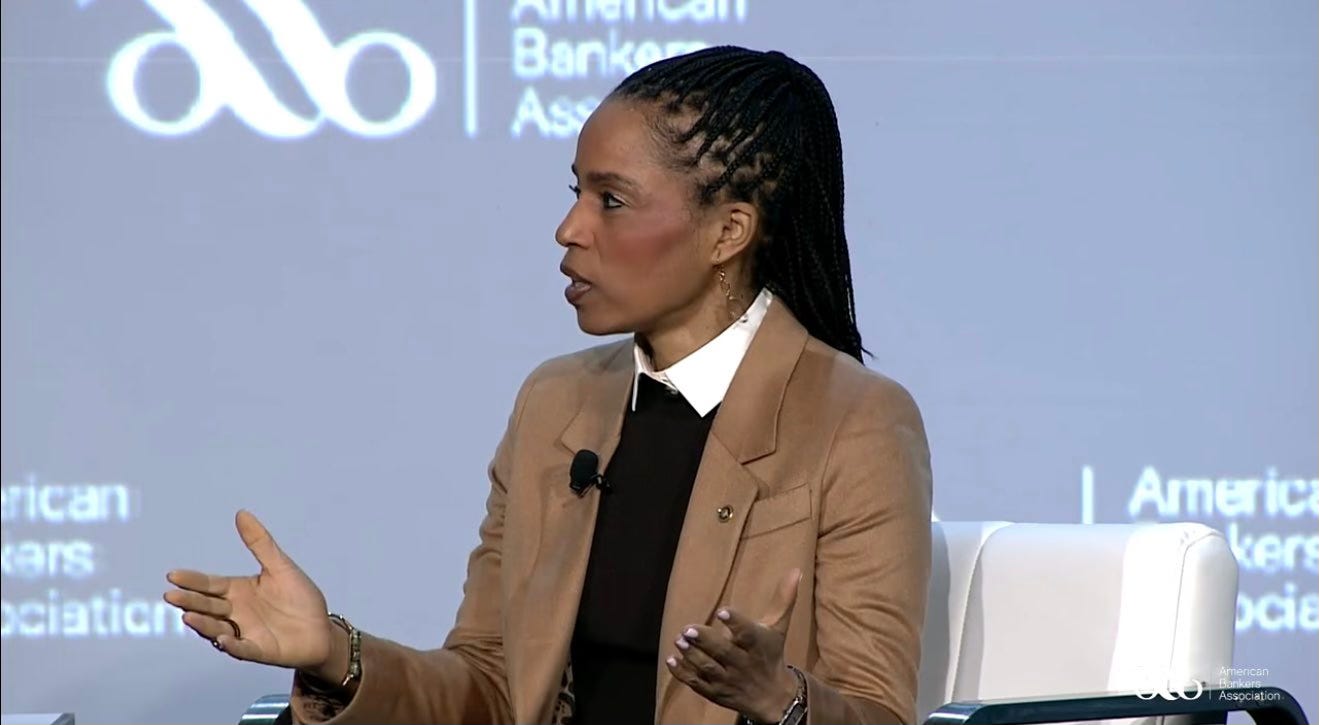
Senator Angela Alsobrooks (D-MD) had a message of pragmatism for a room full of community bankers Tuesday morning at the American Bankers Association Summit in Washington, D.C.: You can’t always get what you want.
“I think I have to level set that all of us will probably walk away just a little bit unhappy,” she told ABA Chief Policy Officer Naomi Camper, referring to the dispute between the banking and crypto industries over whether crypto firms should be allowed to offer rewards on stablecoin holdings.
“It is not letting perfect be the enemy of good […] we’re going to probably have to make some compromises,” she said.
Alsobrooks’ comments come as the standoff remains the elephant in the room holding up the Clarity Act, the Senate’s crypto market structure bill.
Following a month of negotiations brokered by the White House between representatives from the crypto industry and banks, the process has shifted back to Capitol Hill. Alsobrooks and Senator Thom Tillis (R-NC) met crypto and banking stakeholders in recent days to provide feedback on legislative text that emerged from those talks.
“The compromise that myself and Senator Tillis have been working on is one we believe will help us have the guardrails in place that will help us to prevent deposit flight […] and allow innovation to grow at the same time,” Alsobrooks told Camper.
She went on to say that passing the Clarity Act would be preferable to maintaining the status quo: the GENIUS Act as it currently stands allows crypto exchanges to continue offering yield and rewards unrestricted.
Camper emphasized that community banks are particularly concerned about the “dangers of deposit flight,” whereby customers move money out of traditional bank accounts and into higher-yielding stablecoin products offered by crypto firms. While banks argue this is the biggest risk of allowing yield and rewards, crypto advocates say the concern is overblown and reflects banks’ fear of new competition.
White House Crypto Council Executive Director Patrick Witt took to X on Wednesday to point out that crypto companies, which until recently were largely unregulated, have been offering yield and rewards to customers for years, seemingly without major complaints of deposit flight.
“Where is the deposit flight? Is it in the room with us right now?” he quipped.

Witt’s comment suggests negotiators may be starting to chafe at the process, which has dragged on for the better part of nine months. While discussions to resolve the remaining issues in the bill are ongoing, it’s unclear when a compromise will be reached that would allow the Senate Banking Committee to reschedule a markup.
“We are continuing our dialogue with stakeholders on both sides to work toward a compromise,” a press rep for Tillis told Crypto In America.
What a final compromise will look like is also uncertain, but Alsobrooks’ remarks suggest some kind of activity-based rewards may be considered, and any kind of yield on idle balances would be a non-starter.
“We agree, in some occasions on activity that we should be allowed to pay interest in yield — that cryptocurrencies can — but it would be really important that we do not allow the payment on a stable balance that would cause deposit flight,” Alsobrooks said to a hearty round of applause from the bankers in the room.
SEC Reveals New Details on CFTC Harmonization
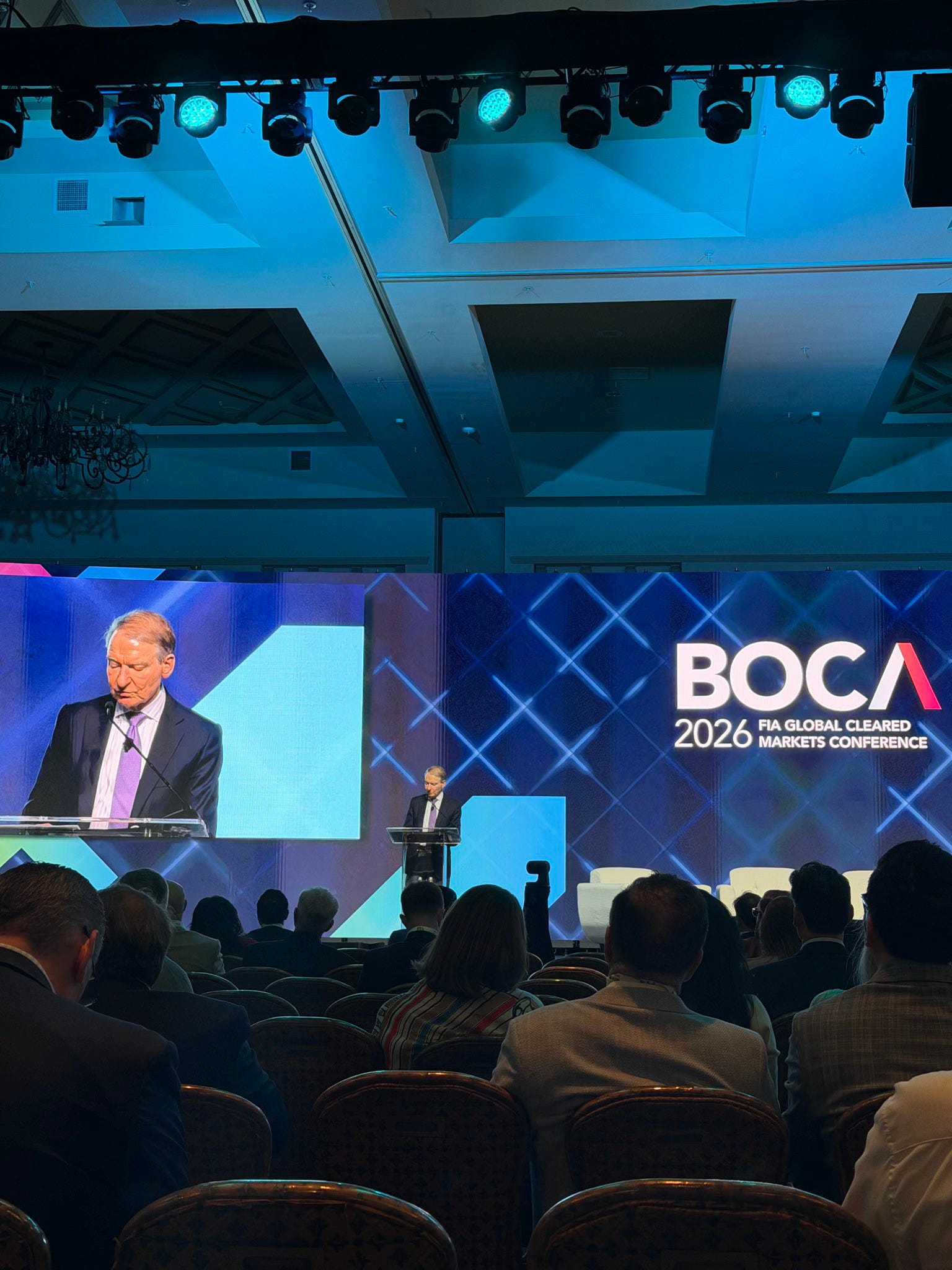
The roadmap for closer regulatory coordination between the Securities and Exchange Commission and the Commodity Futures Trading Commission is beginning to take shape.
Speaking at the flagship futures industry conference in Boca Raton, Florida, SEC Chair Paul Atkins outlined new steps the sister agencies are taking to better coordinate oversight of derivatives and cryptocurrency markets.
Atkins said the “regrettable era of duplicative enforcement actions” between the regulators should come to an end, arguing that the agencies should align their legal theories and remedies when pursuing cases involving the same conduct.
He also raised the concept of “substituted compliance,” under which satisfying the regulatory framework of one agency could meet overlapping requirements of the other if the two regimes produce comparable outcomes. The approach, he said, could help reduce regulatory duplication for firms registered with both agencies.
As part of the effort, Atkins said the SEC plans to launch a new SEC-CFTC harmonization webpage where companies can request coordinated discussions with staff from both regulators when seeking guidance or launching new products. The agencies are also planning to hold joint meetings on new and pending product applications in an effort to speed up the approval process.
Atkins also called for greater cross-agency clarity on prediction market event contracts, including whether certain products could qualify as security-based swaps or other securities.
In addition, he highlighted cross-margining as a potential way to unlock liquidity currently tied up in separate derivatives accounts, allowing firms to use the same collateral across related trading platforms.
Atkins emphasized, however, that closer coordination does not mean the agencies are merging, despite much speculation in the media on the subject.
“The SEC and the CFTC operate under distinct statutes entrusted to us by Congress, and we must administer those mandates faithfully,” he said. “But fulfilling our responsibility does not require fragmentation; in fact, it calls for coordination.”
A recent Bloomberg report said the two regulators are considering moving under one roof, with discussions underway for the CFTC to potentially relocate to the SEC’s headquarters next to Union Station in Washington, D.C., a move that could help streamline coordination.
A source inside the CFTC confirmed to Crypto In America that the agency is evaluating several potential locations but acknowledged that the SEC building is “probably top of the list.” The source stressed that no decision has been made and that multiple parties beyond the two regulators are involved in the discussions.

Invest as you spend with the Gemini Credit Card®. Earn up to 4% crypto back on every purchase with no annual fee.
Gemini-branded credit products are issued by WebBank. This is not investment advice and trading crypto involves risk. See Rates & Fees.
Inside Stripe’s $1B Stablecoin Bet with Bridge Co-Founder Zach Abrams
This week on the Crypto In America podcast, the team sits down with Zach Abrams, co-founder of Bridge, a stablecoin infrastructure platform acquired by fintech giant Stripe in 2025.
In this conversation, Abrams walks us through his journey across various roles in fintech and crypto before co-founding Bridge and scaling the company fourfold last year amid the boom in stablecoins. The discussion also explores the broader evolution of stablecoin payments, Bridge’s partnership with Visa, the company’s pursuit of an OCC bank charter, and what the next phase of global payment infrastructure could look like.
Watch this episode on all platforms here.
Midweek Recap

ICYMI: Here are some of the biggest stories making headlines this week.
Binance has filed a defamation lawsuit against the Wall Street Journal in the Southern District of New York. The exchange is seeking damages and legal fees and is demanding a jury trial.
The lawsuit comes on the same morning the Wall Street Journal reported that the Department of Justice is allegedly investigating claims that Iran used Binance’s platform in order to evade sanctions.
The DOJ has asked to retry Tornado Cash co-founder Roman Storm on the two counts of money laundering and sanctions violations that a jury could not reach a unanimous verdict on in the original trial. Prosecutors proposed an early October retrial date.
U.S. inflation remains at 2.4%, in line with expectations.
Mastercard is launching a Crypto Partner Program with 85 companies including Circle, Paxos, Ripple, PayPal, Gemini and Binance to develop cross-border transfers, B2B payments and global payouts.
Wells Fargo filed a trademark application for “WFUSD,” covering a wide range of cryptocurrency trading, payments and tokenization services, and sparking speculation the bank may be planning to launch its own stablecoin.
Goldman Sachs is now the largest buyer of XRP ETFs with $153.8M in holdings.
Remember, new editions of the Crypto In America newsletter drop every Monday and Wednesday.
If you like what you’re reading, don’t forget to subscribe!