

Welcome to another edition of the Crypto In America newsletter!
What you’ll read: A breakdown of crypto’s roller coaster week in D.C. and a scoop on how Visa is closing a loophole that allowed memecoin purchases to earn ordinary credit card rewards. Plus, a roundup of the week’s biggest stories.
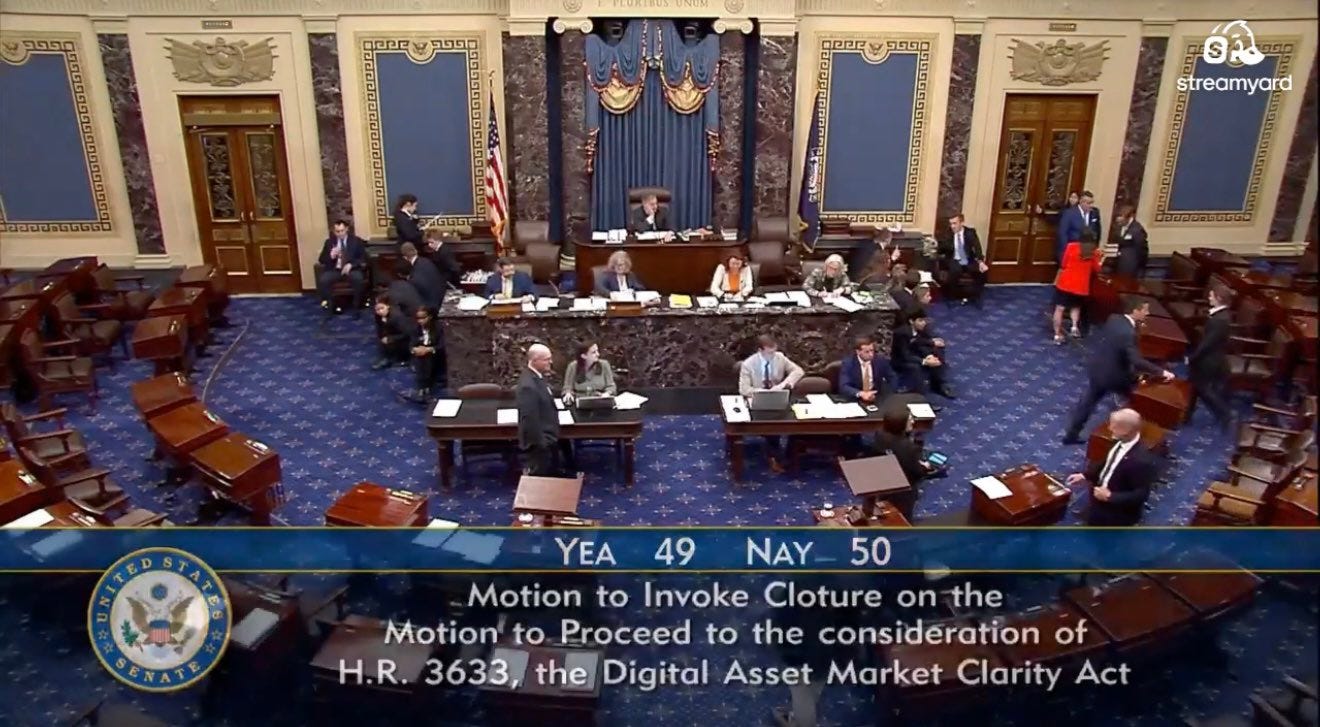
For anyone tracking the twists and turns of crypto policy in Washington, it was a long and bruising week. It also marked a shift in the center of gravity from Congress to the regulators.
On Tuesday, the Senate failed to advance crypto’s landmark market structure bill in a dramatic procedural vote that exposed how deeply President Trump’s crypto dealings have eroded Democrats’ willingness to work with Republicans on regulating an industry they themselves say badly needs oversight.
Democrats voted as a bloc against advancing the bill, while Republican Sens. Susan Collins (R-ME), Josh Hawley (R-MO) and Jerry Moran (R-KS) joined them in opposition. Senator Thom Tillis (R-NC) initially voted yes before switching to no, a procedural maneuver that preserved the option of bringing the bill back at a later date.
That left the final recorded tally at 49-50, well short of the 60 votes needed to advance the bill after more than a year of grueling bipartisan negotiations.
Down in the basement of the Capitol, those negotiations continued right up until the vote began. A Democratic staffer told Crypto In America that Tillis was willing to delay the vote to keep negotiating, but that a staffer for Senate Banking Committee Chair Tim Scott (R-SC) abruptly ended the talks without explanation.
The breakdown quickly gave way to finger-pointing on both sides, with Republicans accusing Democrats of never being serious about passing the bill and Democrats accusing Republican leaders of forcing the vote before negotiations were finished to protect what one staffer called Trump’s “grift.”
“Senate Democrats proved they were never truly serious about protecting consumers and preserving American leadership,” the bill’s chief architect, Sen. Cynthia Lummis (R-WY), said. “I sat at the table with Senate Democrats working in good faith to get this done while they played games.”
But some of the same Democrats who voted no insist the bill isn’t dead.
“It’s not going to die,” Sen. Angela Alsobrooks (D-MD) told Crypto In America immediately after the vote. “You know why it’s not going to die? Because over 70 million Americans are engaging in an industry that is unregulated, and we have a responsibility to regulate.”
Alsobrooks was joined by six other Democrats involved in the negotiations: Sens. Kirsten Gillibrand (D-NY), Mark Warner (D-VA), Cory Booker (D-NJ), Catherine Cortez Masto (D-NV), Ruben Gallego (D-AZ) and Raphael Warnock (D-GA). The group called this week’s vote “a setback, but not the end” and said it remained “committed to working in a bipartisan fashion” to pass the Clarity Act.
The statement lands amid early efforts to restart bipartisan talks and gauge appetite on both sides for returning to the table, according to three sources familiar with the discussions.
But there is significant fatigue across the industry, with many now looking to regulators to write the rules of the road rather than waiting on Congress.
“Congress passed the GENIUS Act and pushed hard on the Clarity Act, but the political will to get it across the finish line wasn’t there. Congress had its chance and didn’t rise to it,” said Solana Policy Institute President Kristin Smith. “We’re now looking to regulators for guidance, and that’s the more viable path forward right now.”
SEC Chairman Paul Atkins explicitly tied the agency’s new innovation exemption to the Clarity Act’s failure to advance in the Senate. The SEC released the highly anticipated measure Thursday, opening a pathway for tokenized U.S. stocks to trade onchain and fueling fresh excitement across the industry as regulators move to take the lead.
The CFTC is also moving ahead. Staff issued a no-action position for passive software providers, while the agency submitted a broader crypto markets rulemaking proposal to the White House for review. Details of the proposal are not yet public.
The industry is getting clarity in one form or another. For now, it will come with a lowercase “c,” delivered by regulators rather than Congress.

Georgetown’s Financial Markets Quality Conference returns September 23
Join Georgetown University’s Psaros Center for its annual Financial Markets Quality Conference, bringing together leaders from finance, government and policy.
This year’s agenda features digital assets, tokenization, prediction markets, private markets and financial regulation, with speakers including CME CEO Terry Duffy, JPMorgan Asset & Wealth Management CEO Mary Callahan Erdoes, Sen. Bill Hagerty (R-TN), NEC Director Kevin Hassett, former Treasury advisor Tyler Williams and White House Crypto Council Executive Director Patrick Witt.
Location: Wednesday, September 23 | Georgetown University | 8:00 a.m. - 5:00 p.m.
Registration is complimentary, but advance registration is required.
Visa Moves to Close Memecoin Credit Card Rewards Loophole

Banks came away empty-handed in their bid for tighter restrictions on stablecoin rewards after the Clarity Act failed to advance in the Senate this week. But JPMorgan has scored a narrower victory in a separate fight over credit card rewards on crypto purchases, Crypto In America has learned.
Visa is moving to close an apparent loophole in checkouts powered by Crossmint, a crypto payments infrastructure firm, according to a source familiar with the matter. The workaround allowed memecoin purchases made with Visa credit cards to be processed under a merchant code intended for ordinary digital media.
The move comes after The Block published an investigation finding that users of the Robinhood Wallet and Fomo apps could purchase memecoins with credit cards through Apple Pay or Google Pay without completing a separate KYC process. The Block’s test purchases, powered by Crossmint and made with both Visa and Mastercard credit cards, were coded as “digital goods media,” a category typically used for e-books, movies and music, rather than as crypto transactions. That allowed customers to earn ordinary credit card rewards such as points or cash back on the memecoin purchases.
Chase told The Block that one Visa transaction had not been flagged as a cryptocurrency purchase, had been assigned the wrong merchant category code and should not have earned rewards. The bank subsequently opened a case with Visa challenging the classification. The New York attorney general’s office also told The Block it was aware of and reviewing the matter.
Crossmint defended its approach by pointing to a 2025 SEC staff statement that described certain memecoins as akin to collectibles rather than securities.
When it comes to payment processing, Visa clearly doesn’t agree.
In correspondence reviewed by Crypto In America, the payment giant told at least one industry participant that the merchant code used for digital goods media is not appropriate for memecoin purchases. Visa has also informed payment processors, including Checkout.com, that the code will no longer be accepted for those transactions, the source said. The processors have been given a grace period to wind down the practice, which is expected to end next week.
Visa and Crossmint did not immediately respond to requests for comment.
Memecoin purchases aren’t going away. But the credit card rewards probably are. Going forward, the purchases must be processed as crypto transactions and will be subject to Visa’s corresponding rules and restrictions.
“The message to the crypto industry is clear: Stop being cute, stay in your lane and use the appropriate codes,” the source said.
Washington Can't Give Crypto Regulatory Certainty | Anthony Scaramucci
Recorded at SALT Wyoming, Anthony Scaramucci joined Crypto In America to explain why he believed the Clarity Act was headed for defeat and what Washington’s political dysfunction means for the industry.
The SkyBridge Capital founder and former White House communications director also grades the Trump administration’s crypto agenda, weighs the significance of the GENIUS Act and makes the case for “mama bear” regulation: rules strong enough to protect consumers without smothering innovation. He offers one piece of advice everyone in crypto can use: moisturize.
Catch the full episode on all platforms here.
Weekly Recap

ICYMI: Here are some of the biggest stories that made headlines this week.
The Clarity Act failed to advance in the Senate in a final recorded vote of 49-50 after Democrats voted as a bloc against the measure, citing concerns including insufficient ethics restrictions on President Trump’s crypto interests.
The SEC rolled out its highly anticipated Innovation Exemption, creating a limited, conditional pathway for tokenized U.S. stocks to trade onchain.
CFTC staff issued a no-action position allowing certain passive software providers to operate without registering as introducing brokers. The agency also sent a broader crypto markets rulemaking proposal to the White House for review.
The House Ways and Means Committee approved the Digital Asset Tax Certainty Act, advancing legislation that would clarify the tax treatment of mining, staking and other digital asset activity.
The House Financial Services Committee advanced H.R. 8957, the American Reserve Modernization Act, in a 28-21 vote. The bill would establish a Strategic Bitcoin Reserve and a separate Digital Asset Stockpile within the Treasury Department.
The Federal Reserve raised interest rates by a quarter percentage point, or 25 basis points, bringing the target range to 3.75%-4%. It marked the central bank’s first rate increase in three years.
MoonPay partnered with WisdomTree to expand U.S. access to WTGXX, WisdomTree’s tokenized Treasury money market fund. MoonPay also plans to use the fund as a reserve asset for its stablecoins.
Coinbase said it filed for regulatory approval to list roughly 50 to 60 U.S. single-stock perpetual futures, with plans to offer 24/5 trading if approved.
Nasdaq is set to introduce 23-hour weekday trading on Dec. 6, while the SEC is examining what a broader move toward round-the-clock trading would require.